Kelly Criterion in Esports: How to Calculate the Ideal Bet Size Based on Probabilities
Learn how to protect your bankroll from emotional esports bets with the Kelly Criterion. Discover how to identify value, calculate stakes, and adapt risk via Quarter-Kelly.
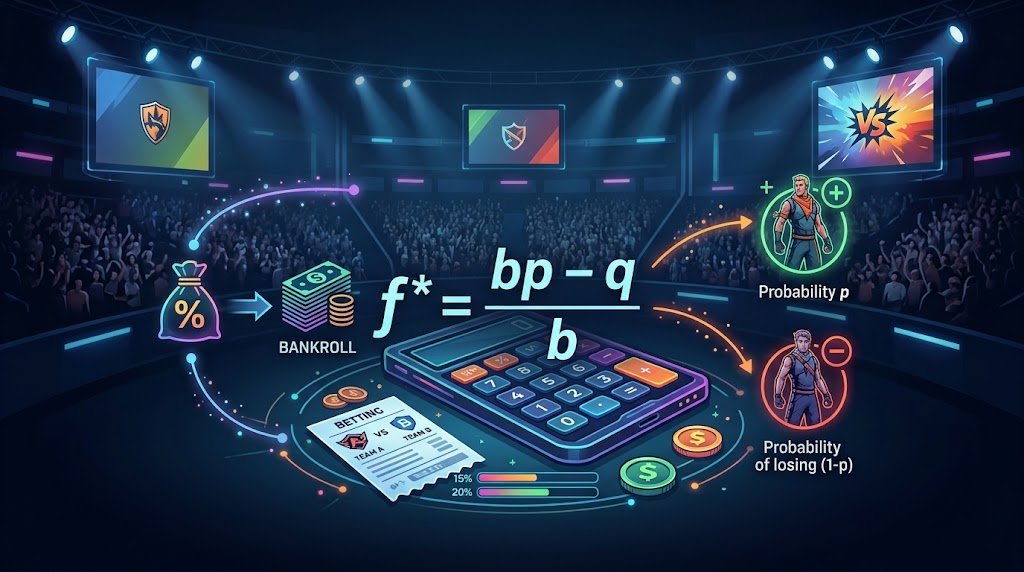
Most esports bettors blow their bankrolls not because of poor predictions, but due to chaotic financial management. Betting "by feel" or using flat stakes completely ignores the primary driver of long-term profit: identifying discrepancies in bookmaker lines (value betting).
The Kelly Criterion is a mathematical bankroll management tool designed to calculate the optimal bet size based on your expected value. In dynamic esports titles (CS 2, Dota 2, LoL) characterized by sudden patches and frequent live bookmaker mispricing, the Kelly Criterion serves as the primary shield against tilt and bankroll destruction.
Use Ensitics.io as your pre-match checklist — try it for free → ensitics.io
1. Kelly Criterion Mathematics: Formula and Variables
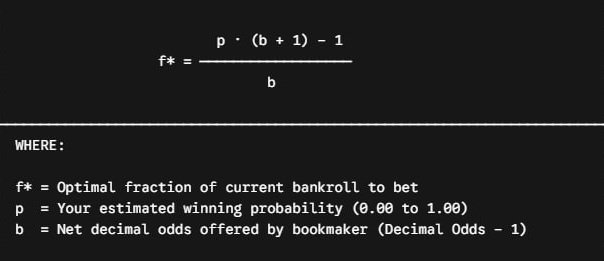
The classical Kelly formula determines the percentage of your current bankroll (f*) that should be wagered on an outcome with positive expected value:
Step-by-Step Calculation Example for Esports
Consider a CS 2 matchup between Team Spirit and FaZe Clan.
Bookmaker Odds: Team Spirit to win is listed at decimal odds K = 2.10. Therefore, b = 2.10 - 1 = 1.10.
Probability Assessment: After evaluating team form, map pools, and pistol round metrics, you estimate Spirit's true win probability at 55% (p = 0.55).
Applying the Formula:

Result: The formula suggests wagering 14.1% of your bankroll.
Important: If the final output is zero or negative, the bet lacks value (negative expected value). You should never place a bet on such an outcome.
2. Discipline Adaptation: Why Full Kelly Is Dangerous in Esports
The classic (Full) Kelly Criterion assumes ideal conditions where your probability estimate p is 100% accurate. However, esports carries inherently high variance:
CS 2: MR12 economy, consecutive lost pistol rounds, technical pauses, and volatile individual performances.
Dota 2 / LoL: Unexpected experimental drafts, Roshan/Baron steals, and last-minute pre-tournament balance patches.
Overestimating your edge (overconfidence bias) when using Full Kelly quickly results in deep bankroll downswings. Therefore, professional esports bettors rely on the Fractional Kelly Criterion.
3. Practical Strategies: Choosing Your Kelly Fraction
To curb volatility, the calculated stake size is scaled down by a fraction. Here is how risk is distributed with a 100,000 ruble bankroll and a calculated base stake of 14.1% (f*):
Option 1: Full Kelly (100%)
Bet Size: 14,100 rubles (14.1% of bankroll).
Risk Level: Extreme.
Losing Streak Protection: Low.
Application: Not recommended in esports due to the high probability of overestimating edge accuracy.
Option 2: Half-Kelly (50%)
Bet Size: 7,050 rubles (7.05% of bankroll).
Risk Level: Moderate.
Losing Streak Protection: Medium.
Application: Pre-match betting on stable Tier-1 tournaments (EPL, Majors, The International), provided you have comprehensive map pool and draft data.
Option 3: Quarter-Kelly (25%) — Optimal for Esports
Bet Size: 3,525 rubles (3.525% of bankroll).
Risk Level: Minimal.
Losing Streak Protection: Maximum.
Application: Live betting, Tier-2/Tier-3 competitions, qualifiers, and matches right after major balance updates.
4. Checklist: Accurately Determining Probability (p) in Esports
The greatest challenge with the Kelly Criterion is avoiding errors in estimating p. To keep your assessments objective, evaluate these five factors:
Map Pool & Draft Conversion: Never rely on overall win rates alone. Evaluate win rates on specific maps and consider opponent vetoes.
Tournament Format (LAN vs Online): Certain teams struggle under the pressure of a live audience (LAN experience), while others falter in online qualifiers due to ping issues or lack of discipline.
Role of Stand-ins: Replacing a core role (AWPer/IGL in CS 2, Midlaner/Captain in Dota 2) reduces overall team synergy by at least 15–20%.
Head-to-Head History: Analyze stylistic matchups. Aggressive default teams frequently struggle against disciplined, highly structured squads.
Recent Form: Look at individual metrics for key players (Rating 2.0 / KDA) over the last 14 days rather than whole-season averages.
Conclusion
The Kelly Criterion bridges the gap between esports analytical insight and strict bankroll discipline. It protects your funds during inevitable downswings and scales bet sizes up during winning stretches when you identify significant edge in the betting lines.
Using Quarter-Kelly (25%) keeps risk thoroughly managed: it absorbs errors in probability estimations while guaranteeing steady bankroll compounding over a large sample size.
Read also: Psychology of Tilt: How Esports Player Emotions in CS2 Ruin Solid Accumulators and Predictions; Bankroll Management in Esports: How to Avoid Busting Out on CS2, LoL, and Overwatch 2 Tournaments; Artificial Intelligence vs Expert Opinion: Can Neural Networks Completely Replace Esports Analysts?
FAQ
What does 322 mean in esports?
322 is slang for a match-fixing incident. The term originated from an infamous Dota 2 case where a professional player bet against his own team to win $322.
How can you tell if a match might be fixed?
No single indicator is definitive. You should assess several red flags together: tournament tier, team reputation, drastic unprovoked odds shifts, suspicious in-game blunders, and the tournament operator's track record.
Does match-fixing happen at Tier-1 events?
Yes, the possibility cannot be ruled out completely. However, Tier-1 events carry far lower risk due to substantial player salaries, severe reputational consequences, and intense scrutiny from organizers, spectators, and bookmakers.
Why do bookmakers adjust betting odds?
Most line movements stem from breaking roster news, player injuries, changes in form, or heavy wagering volume on a specific market. An abrupt, unexplained shift can nonetheless point toward a suspicious match.
What is spot-fixing?
Spot-fixing targets a specific in-game occurrence rather than the final outcome of the entire match. Examples include conceding First Blood in Dota 2 or intentionally throwing the opening pistol round in CS2.
Is it worth betting on lower-tier tournaments?
Beginners should stick to premier international events. Obscure online events lack reliable operational data, and the risk of encountering suspicious or fixed games is significantly higher.

How to Turn Baron and Dragon Fights into Profitable Live Bets in LoL
Epic objectives in LoL are the primary catalyst for thrilling comebacks and swift map finishes. We explore how to predict Soul Point fights, avoid Baron traps, and profit from live betting.
Agent Synergy in Valorant: Why a Pick Without a Duelist or Initiator Is Doomed to Fail
Agent selection in Valorant often decides the outcome before the first round. We analyze why lacking a Duelist costs space, a pick without an Initiator blinds the team, and how this impacts every map.
MR12 Economy in CS 2: How the Format Change Shifted the Value of Pistol Rounds and Force-Buys for Totals Betting
CS2's transition to MR12 increased the value of each round by 20%. Discover why pistol wins trigger Unders and how second-round force-buys drive Overs.