Tilt Psychology: How Esports Players' Emotions in CS2 Ruin Ironclad Expresses and Predictions
Esports seems like a realm of pure math and numbers. However, as long as real people sit behind the monitors, tilt remains the main hidden risk factor. We break down the chain reaction of emotional breakdowns, the first map syndrome, and how to read team mental states in real time.
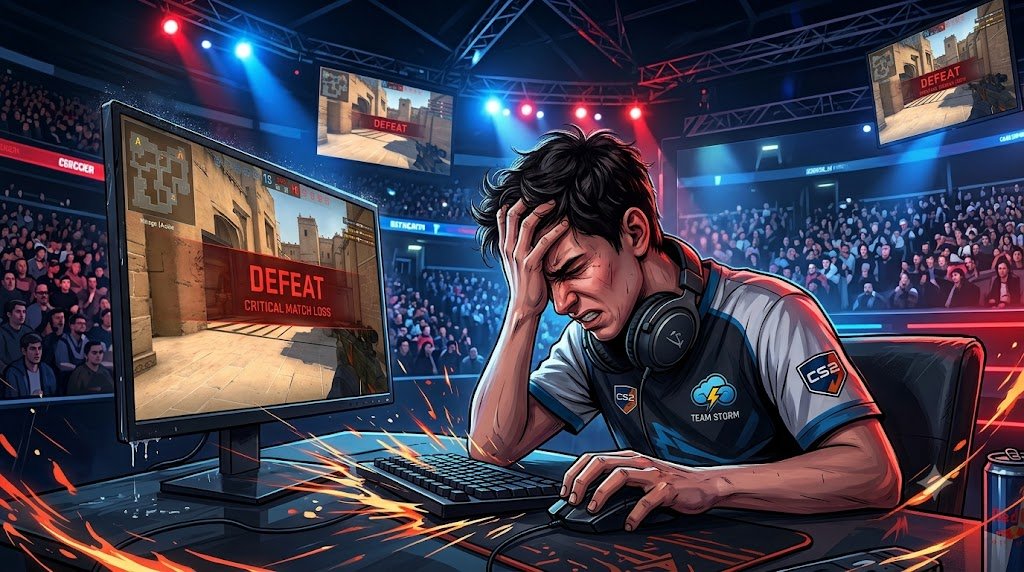
In the world of sports analytics and predictions, esports was long considered a realm of "pure mathematics." Unlike traditional football or tennis, where a player's injury or weather conditions can instantly alter the balance of power, esports seems like an ideal model: dry stats, constant updates, transparent timings, and kilobytes of API data.
However, there is a factor capable of turning an ideal "ironclad" parlay into dust in a matter of minutes. That factor is tilt.
What is tilt and how does it work on stage?
Tilt is a state of emotional irritation caused by failure, a mistake, or an opponent's provocation, in which a player loses control over their actions, starts making irrational decisions, and commits severe errors.
The term originated in poker, but in CS2, League of Legends, and Dota 2, it has taken on a destructive scale. Unlike solo games, tilt in team disciplines works on the principle of a chain reaction:
Spark: A painful 1v3 round loss or a foolish death of a key player.
Short circuit: Loss of concentration, a sharp spike of cortisol and adrenaline.
Contagion: The captain falls silent, the support sighs irritably into the mic, and the carry starts going solo.
Collapse: The team loses strategic discipline and gives away a series of maps without a fight.
Why are algorithms and math powerless against tilt?
When an analyst or mathematical model builds a match prediction, it relies on past merits: win rate on specific maps and heroes, average K/D over recent months, draft efficiency, and head-to-head history.
But no algorithm in the world is capable of measuring a player's level of mental exhaustion directly during a game. Here is how statistics crumble under the pressure of emotions:
Aggressive pick
By stats: High-risk strategy with high potential reward (High risk / High reward).
During tilt: An impulsive buyback or a solo overextension out of desperation.
Timing changes
By stats: A well-thought-out attempt to catch the opponent off guard.
During tilt: A banal loss of time awareness due to stress and panic.
Communication
By stats: Rotations perfected over years and well-drilled setups.
During tilt: Complete silence in TeamSpeak ("silent tilt") and ignoring team calls.
Use Ensitics.io as your pre-match checklist — try for free → ensitics.io
Anatomy of a Breakdown: How Favorites Crumble
The history of esports knows hundreds of examples where favorites with odds of 1.15 lost to underdogs simply because they emotionally "burned out" right on stage.
1. "First Map" Syndrome
The most common scenario for parlays. The favorite takes the first map 13:2, but on the second map, the underdog unexpectedly wins a force buy round and pulls ahead. The favorite, already tuned in for an easy walk, faces resistance, tilts from their own mistakes, and gives away the map. The third map then turns into a psychological roulette.
2. The "Trash Talk" and Provocation Factor
In games like CS2 or Overwatch, emotions are broadcast directly on stream. A few disrespectful gestures (crouch-spamming / teabagging), a disconnect before a bomb explosion, or taunts in all-chat can unbalance even a seasoned veteran. The player starts seeking revenge, forgetting about the original game plan.
3. Favorite Pressure
The higher the stakes, the heavier the tilt. When the favorite realizes they are losing to a lower-tier team, the fear of public embarrassment is added to the emotional tension. Hands start "shaking," and reactions drop by critical fractions of a second.
How to account for the mental factor in match analysis?

To safeguard your predictions and avoid falling victim to a team's sudden tilt, experienced analysts pay attention to non-in-game indicators:
Player cams during pauses: If after a lost round players actively discuss mistakes without aggression — the team is fine. If they sit staring at the desk or argue heatedly — expect trouble.
Comeback history: Teams with a strong mental roster know how to lose first maps and come back into the game. "Tilt-prone" teams crumble at the first serious pushback.
Presence of a sports psychologist: Having an in-house psychologist in the organization (as has long been standard for top tags) is a crucial factor in tilt resistance during long tournament marathons.
Conclusion
Psychology is the invisible sixth player in every esports discipline. You can perfectly calculate draft probabilities and gather the best flashbang stats, but as long as real people sit behind the monitors, tilt will remain the main destroyer of any "ironclad" analytical models.
The ability to read a team's emotional state in real time is what separates a superficial number enthusiast from a true expert.
FAQ
What is 322 in esports?
322 is slang for a match-fixing incident. The term originated after a famous Dota 2 case where a player bet against his own team and stood to win $322.
How to tell if a match might be fixed?
A single sign is not enough. Usually, you should pay attention to several factors at once: the tournament level, team reputation, sudden odds movements, suspicious in-game episodes, and organizer transparency.
Do fixed matches happen at Tier-1 tournaments?
Yes, that possibility cannot be completely ruled out. However, at major international tournaments, the likelihood of 322 is significantly lower due to high player salaries, reputational risks, and increased scrutiny from organizers, viewers, and bookmakers.
Why do bookmakers change odds?
Most often, this is related to roster news, injuries, changes in team form, or a large volume of bets on a specific outcome. However, a sharp line movement without an obvious reason can be one indicator of a suspicious match.
What is spot-fixing?
Spot-fixing is an attempt to influence a specific in-game event rather than the outcome of the entire match. For example, losing first blood in Dota 2 or intentionally throwing the first round in CS2.
Is it worth betting on obscure tournaments?
If you are a beginner, it is better to focus on major international championships. On obscure online tournaments, it is harder to find reliable information about teams and organizers, and the risks of encountering suspicious matches are objectively higher.

How to Identify a Suspicious Match and Avoid Match-Fixing (or 322)
It is impossible to completely eliminate the risk of encountering a fixed match. However, understanding how to spot 322 and what to look out for will significantly lower your chances of making a mistake.
Artificial Intelligence vs. Expert Opinion: Can a Neural Network Completely Replace an Esports Analyst?
Machine learning algorithms process gigabytes of tournament data in seconds, finding hidden patterns and building mathematical models with incredible accuracy. But can neural networks completely write off the human factor, intuition, understanding of players' psychological state, and insider knowledge? We break down the showdown between AI and expert analysis in esports.
Bankroll Management in Esports: How Not to Lose Everything at CS2, LoL, and Overwatch 2 Tournaments
Major tournaments like the CS2 Major or LoL Worlds are the biggest temptation for an esports analyst. A constant flow of matches, excitement, and sharp odds shifts often lead to a wiped-out deposit in a single weekend. We break down the mathematics of bankroll management and adapting bet sizes to three key disciplines.