Artificial Intelligence vs. Expert Opinion: Can a Neural Network Completely Replace an Esports Analyst?
Machine learning algorithms process gigabytes of tournament data in seconds, finding hidden patterns and building mathematical models with incredible accuracy. But can neural networks completely write off the human factor, intuition, understanding of players' psychological state, and insider knowledge? We break down the showdown between AI and expert analysis in esports.
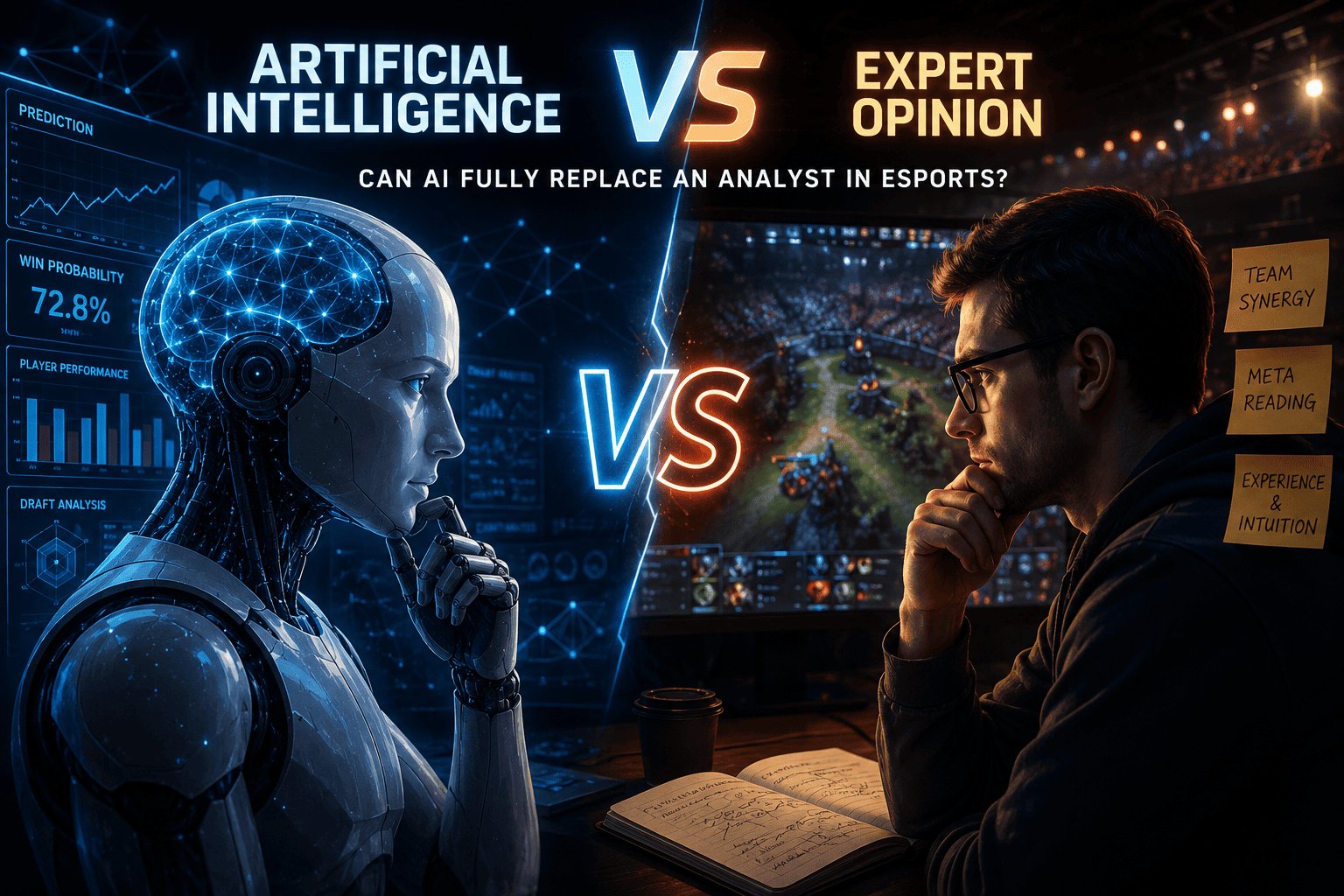
Every year, esports becomes increasingly high-tech. The main advantage of digital sports over traditional ones is 100% digitization: every player action, crosshair movement, micro-swap, ward placement timing, or grenade purchase instantly turns into logs and datasets.
Against this backdrop, neural networks and machine learning algorithms are actively developing, claiming the role of primary analysts. AI-powered projects are capable of providing real-time mathematical win probabilities for teams, outpacing the reactions of traditional tipsters. However, a key question arises: can an algorithm completely displace human analysts from esports, or does human perception have protected zones inaccessible to code?
Table of Contents
Where AI Surpasses Humans: Scale, Speed, and Absence of Emotions
Algorithm Blind Spots: What Neural Networks Can't See
Discipline Specifics: Where Algorithms Are Stronger and Where They Falter
Counter-Strike 2: Micro-Data vs. Tilt Factor
League of Legends: Complex Meta-Patches and Draft Adaptation
Overwatch 2: Visual Chaos and Dynamic Team Synergy
Comparative Analysis of Systems and Risk Management Parameters
Hybrid Model: The Alliance of Human and Algorithm as the Pinnacle of Analytics
Checklist: When to Trust the Algorithm and When to Trust an Expert
Conclusion
1. Where AI Surpasses Humans: Scale, Speed, and Absence of Emotions
Machine learning fundamentally changes the approach to information processing. In certain aspects of data handling, humans objectively cannot compete with algorithms.
Key Advantages of Neural Networks
Multifactorial analysis without attention limits: The human brain can simultaneously consider and weigh no more than 3–5 variables. A neural network instantly correlates hundreds of parameters: from a player's win rate on a specific map under specific economic conditions to the effectiveness of grenade usage against particular opponents.
Complete absence of cognitive biases: A human analyst is subconsciously prone to recency bias, sympathy for certain rosters, or belief in a team's beautiful comeback story. AI operates purely with mathematical expectation and raw probability.
Instant live reaction: During live betting, the algorithm recalculates odds in fractions of a second after first blood or securing a key objective, whereas a human needs time to process the situation.
2. Algorithm Blind Spots: What Neural Networks Can't See
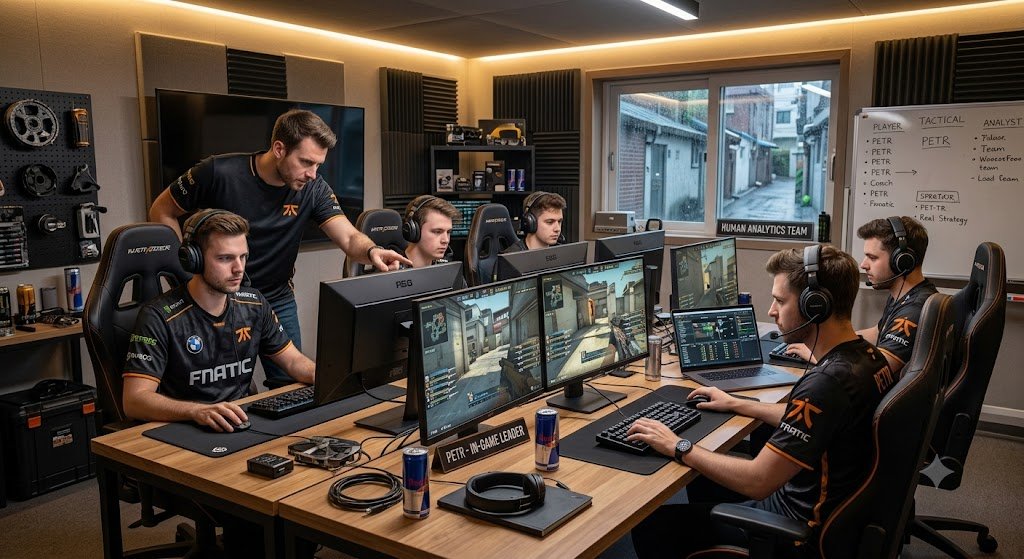
The main drawback of any artificial intelligence is that it sees exclusively past figures and structured data. The algorithm does not understand context that goes beyond dry statistics.
What Cannot Be Digitized
Qualitative non-gaming context: Flight delays, jet lag, food poisoning, internal team conflict, or player illnesses do not show up in server logs until the match is lost.
Psychology and mental breakdown: A neural network can calculate a team's chance of winning at an 11:4 score, but it cannot measure the captain's level of tilt after losing a one-v-three clutch.
Radical patch changes: When developers release a global update (such as a map rework or large-scale character rebalancing), the AI's historical database partially loses relevance. A human analyst adapts to the new meta faster than an algorithm thanks to an understanding of the game's conceptual logic.
3. Discipline Specifics: Where Algorithms Are Stronger and Where They Falter
Counter-Strike 2: Micro-Data vs. Tilt Factor
Shooters have a clear mathematical structure, making them an ideal testing ground for algorithms.
AI strength: Precise probability calculation based on duel analysis, headshot percentage, grenade utility efficiency, and the MR12 economic model.
Expert advantage: Assessing a team's psychological state in a stadium with live crowds, understanding emotional pressure in deciding rounds, and reading players' body language during technical pauses.
League of Legends: Complex Meta-Patches and Draft Adaptation
In MOBA games, character combinatorics and strategic design play a massive role.
AI strength: Modeling draft outcomes based on thousands of past champion matchup combinations and synergy win rates.
Expert advantage: Understanding unconventional strategies and signature setups used by a team for the first time. AI treats a hybrid or rare pick as a statistical anomaly, whereas an analyst recognizes it as a well-thought-out counter-pick.
Overwatch 2: Visual Chaos and Dynamic Team Synergy
The high dynamic pace of Overwatch 2 creates special challenges for both sides.
AI strength: Fast calculation of cumulative damage, ultimate charge speed, and frequency of successful hero swaps at spawn.
Expert advantage: Assessing lineup flexibility during opponent tactical shifts and identifying which player is the emotional leader keeping the roster from falling apart.
4. Comparative Analysis of Systems and Risk Management Parameters
Below are the efficiency and risk parameters when using pure AI, human analysis alone, or a combination of both.
Pure AI Analysis
Context vulnerability level: Highest.
Main risk: Inability to account for fresh news about substitutions, illnesses, logistics, and psychological issues within the team.
Efficiency: Maximum over a long distance under stable conditions and established patches.
Flat parameters: Fixed 0.5% – 1.0% of bankroll strictly according to mathematical expectation.
Pure Expert Analysis
Context vulnerability level: Low.
Main risk: Subjectivity, emotional errors, tilt, overestimating favorite players, and fatigue during long working hours.
Efficiency: High in non-standard situations, in tournaments immediately following new patch releases, and in final playoff stages.
Flat parameters: Dynamic 1.0% – 1.5% with the option to skip suspicious matches.
Hybrid Approach — AI plus Expert
Context vulnerability level: Minimal.
Main risk: Misinterpretation of algorithm signals by a human.
Efficiency: Highest ROI over distance thanks to a combination of data speed and contextual control.
Flat parameters: Optimal 1.5% – 2.0% on events validated by both sides.
Use Ensitics.io as your pre-match checklist — try for free → ensitics.io
5. Hybrid Model: The Alliance of Human and Algorithm as the Pinnacle of Analytics
Artificial intelligence will not replace experts entirely, but experts who use AI will inevitably replace experts who do not.
The most effective operating model functions as a two-tier filter:
[ Big Data Array ] ➔ [ AI Algorithm: Filtering value and math ] ➔ [ Expert: Contextual and psychological filter ] ➔ [ Final decision ]Primary selection done by AI: The algorithm scans hundreds of matches, finds line discrepancies, and provides pure probability.
Final filter applied by human: The expert reviews the selected options through the lens of news, logistics, player form, arena atmosphere, and roster motivation.
6. Checklist: When to Trust the Algorithm and When to Trust an Expert
Use this decision-making framework when evaluating predictions:
Has a new patch been released in the last 7 days? If yes, prioritize expert opinion. If no, rely on AI models.
Is the team experiencing severe jet lag or flight delays? If yes, adjust AI math calculations downwards.
Is it an online stage or a stadium LAN with a live crowd? At LAN arenas, the emotional factor is higher, increasing the weight of expert analysis.
Do the AI and expert conclusions align? If the mathematical model and contextual analysis point to the same outcome, this signals maximum confidence.
Is the match played in Bo1 format? Bo1 has a high level of variance where AI may fail to consider the random factor of pistol rounds.
7. Conclusion
Neural networks will not be able to completely push analysts out of esports in the near future. AI is ideal as a super-intensive assistant that handles routine tasks: gathering statistics, calculating baseline probabilities, and tracking real-time anomalies.
However, as long as esports players remain living human beings with emotions, fatigue, personal problems, and complex psychology, the final say in complex analytics belongs to humans. The future of esports analysis lies neither in blind reliance on code nor solely on intuition, but in their harmonious hybrid alliance.
FAQ
What does it mean to bet smarter on esports? Betting smarter means replacing intuitive decisions with a consistent analytical process: confirming rosters, checking current form, evaluating value in odds, and placing bets only when facts clearly support your choice. This does not guarantee a win on every bet, but it increases decision quality over distance, turning the process into measurable results.
How do you get an edge in esports betting? An edge is achieved by consistently finding situations where your assessment of an outcome is more accurate than what bookmakers factored into the odds. This requires a repeatable pre-match analysis, honest tracking of statistics, and selectivity — the ability to skip matches that do not meet your criteria instead of placing bets on everything.
Is it worth using tipster services or analyzing matches yourself? Tipsters earn money by selling predictions, not necessarily because those predictions turn a profit. The only way to know if an analytical process works is to run it yourself and record results honestly. AI-powered forecasting tools like Ensitics.io provide objective data-driven signals without the conflict of interest inherent in paid tipsters — but the final decision always remains yours.
How quickly will I know if my betting strategy works? You need to make at least 50 bets before drawing initial conclusions, and over 100 before trusting identified patterns. On shorter distances, everything is determined by variance: you might get a 70% win rate out of 20 bets through pure luck, or 40% due to a temporary downswing. Track your statistics regularly and review results monthly rather than after every matchday.
What is the difference between High Confidence and Value Spotter signals on Ensitics.io? High Confidence signals focus on reliability — the model highlights matches where statistics clearly point to a specific winner. Value Spotter signals focus on mathematical expectation — they find matches where bookmakers underestimate a team's chances. The first option offers higher hit rates at lower odds. The second option yields higher potential returns but comes with greater variance. Most analysts combine both methods depending on their bankroll size.
→ Read also: Most Common Mistakes in Esports Betting (and How Data Helps Fix Them) → Read also: Best Esports Prediction Tools in 2026 — Ranking and Reviews

Bankroll Management in Esports: How Not to Lose Everything at CS2, LoL, and Overwatch 2 Tournaments
Major tournaments like the CS2 Major or LoL Worlds are the biggest temptation for an esports analyst. A constant flow of matches, excitement, and sharp odds shifts often lead to a wiped-out deposit in a single weekend. We break down the mathematics of bankroll management and adapting bet sizes to three key disciplines.
Anatomy of Non-Gaming Risks in Esports: How Jet Lag, Flights, Climate, and Schedules Break Favorites in CS2, LoL, and Overwatch 2
An esports match result depends only 60% on map pool or draft quality. The remaining 40% is the hidden anatomy of a tournament: multi-hour airport layovers, drastic climate changes, disrupted sleep, night matches, and equipment issues. We break down how physiology, logistics, and psychology affect rosters in CS2, LoL, and Overwatch 2, and how to find mathematical value where others see mere statistical randomness.
OpTic Texas vs Miami Heretics CDL Playoffs 2026 Prediction: The Favorite Aims for Victory
In the decisive stage of the Call of Duty League 2026 season, the champions of Major 4, OpTic Texas, will face the relentless Miami Heretics. We analyze the teams' chances in this Bo5 series.