Bankroll Management in Esports: How Not to Lose Everything at CS2, LoL, and Overwatch 2 Tournaments
Major tournaments like the CS2 Major or LoL Worlds are the biggest temptation for an esports analyst. A constant flow of matches, excitement, and sharp odds shifts often lead to a wiped-out deposit in a single weekend. We break down the mathematics of bankroll management and adapting bet sizes to three key disciplines.
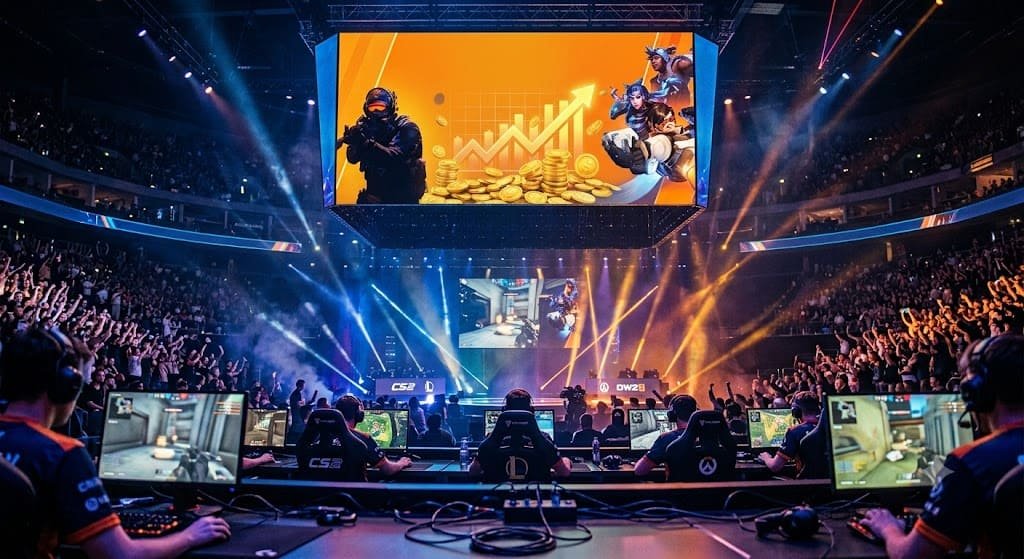
Major esports championships attract immense attention from fans and bettors alike. Matches run continuously from morning till night, bookmaker odds shift rapidly based on team form, and excitement pushes you to increase your stake sizes. However, without a clear system of financial control, even an experienced analyst with a high win rate risks ending up with a zero balance after just a couple of days into the regular season or playoff stage.
Esports betting differs significantly from traditional sports analysis. The rapid pace of game updates, a variety of series formats (Best-of-1, Best-of-3, Best-of-5), and the factor of human error among young players make mathematical variance in esports substantially higher. This guide will help you build a robust bankroll management system and adapt bet sizing to the specifics of three key disciplines — Counter-Strike 2, League of Legends, and Overwatch 2.
Table of Contents
Introduction: Why Classical Bankroll Management Fails in Esports
Fundamental Financial Models and Risk Mathematics
Fixed Flat
Adaptive Flat
Fractional Kelly Criterion
Bankroll Allocation Strategy for a Tournament Period
In-Depth Analysis of Disciplines and Their Variance Profiles
Counter-Strike 2 (CS2): MR12 Economy, Pistol Rounds, and Bo1 Chaos
League of Legends (LoL): Draft Power, Patch Meta, and Bo3/Bo5 Stability
Overwatch 2 (OWCS): Counter-Picks, Micro-Swaps, and Ultimate Economy
Comparative Matrix and Risk Management Parameters
Psychology and Tilt Management during Long Series
Checklist: Working Procedure During a Tournament
Conclusion
1. Introduction: Why Classical Bankroll Management Fails in Esports
Most sports analysts transition to esports with background experience in traditional sports (soccer, basketball, tennis). However, directly transferring classic financial strategies often leads to a rapid loss of capital.
The main reason is the non-linearity and instability of the esports environment:
Meta and Patch Dynamics: Unlike soccer, where rules and game mechanics remain unchanged for decades, esports disciplines receive major updates every few months (and minor ones every 2–3 weeks). A single tweak to weapon stats or champion metrics can instantly drop a scene's dominant force down to a mid-tier level.
Aggressive Formats: At a single tournament, a team might play a coin-flip Bo1 match, proceed through a grueling Bo3 series, and conclude with a five-map Bo5 final. Each of these formats carries a fundamentally different level of variance (mathematical deviation).
Human Factor and Pro Player Age: The average age of esports athletes is 18–23. Emotional instability, tilt from a painful defeat, and fatigue from long match days exert a far greater impact on results than in traditional sports.
To preserve capital and generate long-term profits, a bettor must build a flexible bankroll management system that adapts to each specific game and tournament stage.
2. Fundamental Financial Models and Risk Mathematics

Before evaluating team odds in specific disciplines, you must strictly establish bankroll rules. Progressive betting systems like Martingale or Fibonacci are strictly forbidden in esports — a streak of 4–5 sensational upsets during the group stage will guaranteed destroy your deposit.
Fixed Flat
Model core: the stake is always a strictly defined percentage of the initial bankroll (for example, 1% or 1.5%).
Pros: Full protection against rapid drawdowns, minimal emotional impact.
Cons: Slow bankroll growth despite a high win rate.
Use cases: Play-in stages, online qualifiers, unpredictable Bo1 matches.
Adaptive Flat
Model core: the stake size is recalculated based on the current bankroll depending on event probability and match format. Working range — from 0.5% to 2.5%.
0.5% – 1.0%: High-variance events (Bo1 in CS2, correct score bets, live bets before draft).
1.5% – 2.0%: Standard stake on Bo3 matches between evenly matched opponents or proven markets.
2.5%: Maximum stake size ("lock"). Used exclusively in Bo3/Bo5 series when there is strong value (bookmaker mispricing of draft or form).
Fractional Kelly Criterion
The model calculates the stake size using the formula:

Where:
S — fraction of the bankroll;
p — your mathematical probability estimate of the event (0 to 1);
b — decimal odds from the bookmaker;
k — fraction multiplier (for esports, using k = 0.25 or 0.125, i.e., 1/4 or 1/8 of full Kelly, is recommended).
Example: A bookmaker offers odds of 2.10 on a team winning a Bo3. Your analysis indicates the real winning probability is 55% (0.55).
Full Kelly calculation: (0.55 * 2.10 - 1) / (2.10 - 1) = (1.155 - 1) / 1.10 = 0.155 / 1.10 ~ 0.141 (14.1% of bankroll).
Applying the 1/4 fraction (k = 0.25): 14.1 * 0.25 = 3.52%.
Note: Due to high estimation error in esports, even this calculated figure should be trimmed down to a safe ceiling of 2.5%.
Bankroll Allocation Strategy for a Tournament Period
Never treat a tournament as a single monolith. Allocate no more than 20–25% of your total bankroll to a single tournament.
This limit (tournament sub-budget) is divided across phases:
[Total tournament budget (100% of sub-limit)]
  ├── 15% — Qualifiers / Swiss Stage Bo1 (Scouting, meta gathering)
  ├── 50% — Group Stage Bo3 (Main volume of work)
  └── 35% — Playoffs Bo3 / Bo5 (Operating with maximum precision)
Use Ensitics.io as your pre-match checklist — try for free → ensitics.io
2. In-Depth Analysis of Disciplines and Their Variance Profiles
Counter-Strike 2 (CS2): MR12 Economy, Pistol Rounds, and Bo1 Chaos
CS2 is one of the most mathematically volatile disciplines for betting due to first-person shooter mechanics and the adoption of the MR12 format (first to 13 won rounds).
1. The MR12 Format Factor
In MR12, the number of rounds per side was reduced from 15 to 12. This fundamentally changed the economy:
Pistol Rounds: Winning a pistol round and the subsequent force-buy/eco guarantees a team at least a 2–3 round head start. Out of 12 rounds per side, that is 25% of the entire half.
Cost of Error: Losing a single gun round with a weak economy immediately forces a team into a full eco, gifting the opponent another 1–2 rounds for free.
2. Bo1 Format and Map Pool
At major tournaments (Major, ESL Pro League, IEM), initial rounds are played in a Swiss system using a Best-of-1 format.
An underdog, through smart map vetos, can isolate their single comfortable map (for instance, Anubis or Ancient, where the attacking side holds an edge).
An underdog winning pistol rounds in a Bo1 leads to closing out the map in their favor in 60%+ of cases.
Bankroll Rule for CS2: A strict limit applies to Bo1 matches — no more than 0.5%–0.75% of your bankroll. Entering Bo3 matches is recommended only starting from the second map (live) or after a detailed analysis of side selection and win rates on opponents' map picks.
League of Legends (LoL): Draft Power, Patch Meta, and Bo3/Bo5 Stability
League of Legends is the discipline with the lowest statistical variance among those considered. Here, execution skill, macro play, and clever drafting prevail over random factors.
1. Importance of the Draft Phase (Pick & Ban)
Up to 60–70% of a professional match outcome is determined during champion selection.
Having "meta picks" (champions with excessively high win rates in the current patch) confers a massive advantage.
A team securing strong synergy in the Bot Lane and early control over Rift Herald/Dragons can methodically snowball a gold advantage without taking risky fights.
2. Tournament Format and Adaptation
Tournaments like Worlds and MSI have virtually abandoned Bo1 in key stages, using Bo3 and Bo5 instead. Over a 3 or 5 map series, the impact of an early random error is smoothed out: a tier-1 team has time to adapt its draft strategy and adjust to the opponent's style.
Bankroll Rule for LoL: Pre-match bets on favorites in Bo3/Bo5 suits a standard flat stake of 1.5%–2.5%. The primary spot for maximum value in LoL is live betting right after the draft phase finishes, when bookmaker odds haven't fully reflected the advantage of one draft composition over another.
Overwatch 2 (OWCS): Counter-Picks, Micro-Swaps, and Ultimate Economy
Overwatch Champions Series (OWCS) combines the dynamics of an FPS with the deep strategy of a MOBA. This makes the game medium-to-high variance with a high frequency of emotional comebacks.
1. Counter-Picking Mechanics (Hero Swapping)
Unlike LoL, where drafts are locked for the entire map, Overwatch 2 allows players to swap heroes directly at spawn during combat.
If a team loses the first point, they can completely swap their tank and DPS lineup, neutralizing the opponent's advantage.
This makes pre-match betting on specific maps (especially Hybrid or Push modes) extremely risky.
2. Ultimate Ability Economy (Ult Economy)
Winning a team fight often hinges on which team uses their ultimates more effectively and baits out the enemy's defensive abilities (such as Zenyatta's Transcendence or Lúcio's Sound Barrier). Misusing ultimate abilities by a single key star player can flip the entire round outcome.
Bankroll Rule for OW2: The working flat for OW2 is 1.0%–1.25%. In pre-match, avoid betting on moneyline favorites with low odds. The optimal market choices are map totals (Over/Under) or handicap (+maps) on underdogs in FT3 (First to 3) / Bo5 matches, as the specifics of different map modes (Control, Escort, Flashpoint) allow even weaker teams to take their signature modes.
4. Comparative Analysis of Disciplines and Risk Management Parameters

If your website does not support table formatting, you can evaluate the risks for each discipline using a structured profile system. Below is a detailed breakdown of risk parameters for each game.
Counter-Strike 2 (CS2)
Mathematical Variance Level: High.
Impact of Chance and Mechanics: High (decisive role of pistol rounds, individual aim, criticality of economic errors under MR12).
Optimal Betting Format: Bo3 (playoff matches, group stage deciders).
Worst Betting Format: Bo1 (Swiss system opening rounds).
Main Value Spot: Side swap moment (CT/T), live betting after final map veto and side selection.
Recommended Flat Stake: 0.5% for Bo1 matches; 1.5% for Bo3 setups.
League of Legends (LoL)
Mathematical Variance Level: Low / Medium.
Impact of Chance and Mechanics: Low (systemic macro planning, map objective control, and draft quality dominate).
Optimal Betting Format: Bo3 and Bo5 (longer series smooth out random errors).
Worst Betting Format: Early Bo1 matches in the Play-In stage.
Main Value Spot: Live bets strictly after the Pick & Ban draft phase concludes.
Recommended Flat Stake: 1.5% – 2.5% (for Bo3 and Bo5 matches with a distinct draft advantage).
Overwatch 2 (OWCS)
Mathematical Variance Level: Medium / High.
Impact of Chance and Mechanics: Medium (dynamic hero swaps at spawn, timing, and ultimate synergy).
Optimal Betting Format: Bo5 / FT3 (First to 3) — series where teams have time to play across several different map types.
Worst Betting Format: Bets on individual Control mode maps (highest level of uncertainty).
Main Value Spot: Plus handicap (+maps) and map total markets on underdogs that possess strong signature modes.
Recommended Flat Stake: 1.0% – 1.25% of current bankroll.
5. Psychology and Tilt Management during Long Series
The main enemy of a bettor's bankroll is not a bad draft or a random eco round, but tilt. At major esports tournaments, matches flow continuously from morning until late at night.
The "Three Loss" Rule (Stop-Loss)
If you suffer 3 consecutive losses within a single match day, stop betting for that day entirely.
The brain starts chasing "quick odds" to recover losses.
Probability assessment becomes emotional rather than mathematical.
Daily loss is capped within a safe 3%–5% of the bankroll, which is easily recoverable over time.
"Favorite Team" Syndrome
Esports is closely tied to streaming and player personal brands. Betting on matches featuring fan favorites (e.g., NaVi, T1, Crazy Raccoon) often comes with cognitive bias. If you favor a roster, reduce your stake size by 50% from your standard flat or skip the match entirely.
6. Checklist: Working Procedure During a Tournament
Before placing a bet on an esports tournament match, run through the following checklist:
Discipline and format defined: If it's a Bo1 in CS2 — reduce stake to 0.5%. If Bo3/Bo5 in LoL or OW2 — apply standard flat (1.0%–2.0%).
Tournament budget limit verified: Total value of all open bets currently does not exceed 5–7% of total bankroll.
Patch factor accounted for: Has the tournament run for at least 2 days on the current patch to understand the actual meta rather than relying on outdated stats?
Tournament phase evaluated: For LAN stages with live audiences, adjust for nerves among young players (reduce stakes on inexperienced rosters).
Draft/map veto phase (for live bets): Bet strictly after map picks are revealed (CS2) or after champion/hero drafting is completed (LoL/OW2).
Stop-Loss respected: Is this not your 4th consecutive bet following a losing streak?
7. Conclusion
The success of an esports analyst is defined not by predicting the winner of a single match, but by preserving capital across hundreds and thousands of events. In esports, there is no one-size-fits-all bet amount: flat stake sizes must constantly adapt to match formats (Bo1, Bo3, Bo5) and specific game mechanics.
Use a conservative approach during coin-flip stages of CS2, monetize deep draft understanding in League of Legends, and catch map totals across mode changes in Overwatch 2. Strict financial discipline, adherence to tournament sub-limits, and emotional control are the only ways to turn esports analysis from a gambling hobby into a stable and profitable mathematical system.
FAQ
What does it mean to bet smarter on esports? Betting smarter means replacing intuitive decisions with a consistent analytical process: confirming rosters, checking current form, evaluating value in odds, and entering positions only when facts clearly back your choice. This doesn't guarantee winning every bet, but it increases decision quality over time, turning the process into a measurable result.
How do you gain an edge in esports betting? An edge is achieved by consistently identifying scenarios where your assessment of an outcome is more accurate than what bookmakers priced into the odds. This requires repeatable pre-match analysis, honest statistical tracking, and selectivity — knowing when to skip matches that don't fit your criteria instead of betting on everything.
Should you use tipster services or analyze matches yourself? Tipsters make money selling picks, not necessarily from those picks being profitable. The only way to know if an analytical process works is to run it yourself and honestly track results. AI-based forecasting tools like Ensitics.io provide objective, data-backed signals free of the conflict of interest inherent in paid tipsters — but the final decision always rests with you.
How quickly will I know if my betting strategy works? You need to place at least 50 bets before drawing initial conclusions, and over 100 before trusting identified patterns. Over smaller sample sizes, randomness rules: you might hit 70% wins out of 20 bets purely on luck, or 40% due to a temporary slump. Track your stats consistently and review results monthly, rather than after every match day.
What is the difference between High Confidence and Value Spotter signals on Ensitics.io? High Confidence signals focus on reliability — the model highlights matches where statistics strongly point to a clear winner. Value Spotter signals target expected value — finding matches where bookmakers underestimate a team's real odds. The former yields a higher win rate at lower odds. The latter offers higher potential profit, but comes with higher variance. Most analysts combine both approaches depending on bankroll size.
→ Read also: Most Common Esports Betting Mistakes (And How Data Helps Fix Them) → Read also: Best Esports Prediction Tools in 2026 — Rankings & Reviews
// This week

Anatomy of Non-Gaming Risks in Esports: How Jet Lag, Flights, Climate, and Schedules Break Favorites in CS2, LoL, and Overwatch 2
An esports match result depends only 60% on map pool or draft quality. The remaining 40% is the hidden anatomy of a tournament: multi-hour airport layovers, drastic climate changes, disrupted sleep, night matches, and equipment issues. We break down how physiology, logistics, and psychology affect rosters in CS2, LoL, and Overwatch 2, and how to find mathematical value where others see mere statistical randomness.
OpTic Texas vs Miami Heretics CDL Playoffs 2026 Prediction: The Favorite Aims for Victory
In the decisive stage of the Call of Duty League 2026 season, the champions of Major 4, OpTic Texas, will face the relentless Miami Heretics. We analyze the teams' chances in this Bo5 series.
Esports World Cup 2026 Dota 2 Favourites: Who Will Win in Paris?
As always, every top-tier tournament has its favourites. Some teams arrive in incredible form, others have championship-winning experience, while a few are simply too talented to ignore. Here's a look at the biggest contenders to win the Esports World Cup 2026.