Anatomy of Non-Gaming Risks in Esports: How Jet Lag, Flights, Climate, and Schedules Break Favorites in CS2, LoL, and Overwatch 2
An esports match result depends only 60% on map pool or draft quality. The remaining 40% is the hidden anatomy of a tournament: multi-hour airport layovers, drastic climate changes, disrupted sleep, night matches, and equipment issues. We break down how physiology, logistics, and psychology affect rosters in CS2, LoL, and Overwatch 2, and how to find mathematical value where others see mere statistical randomness.
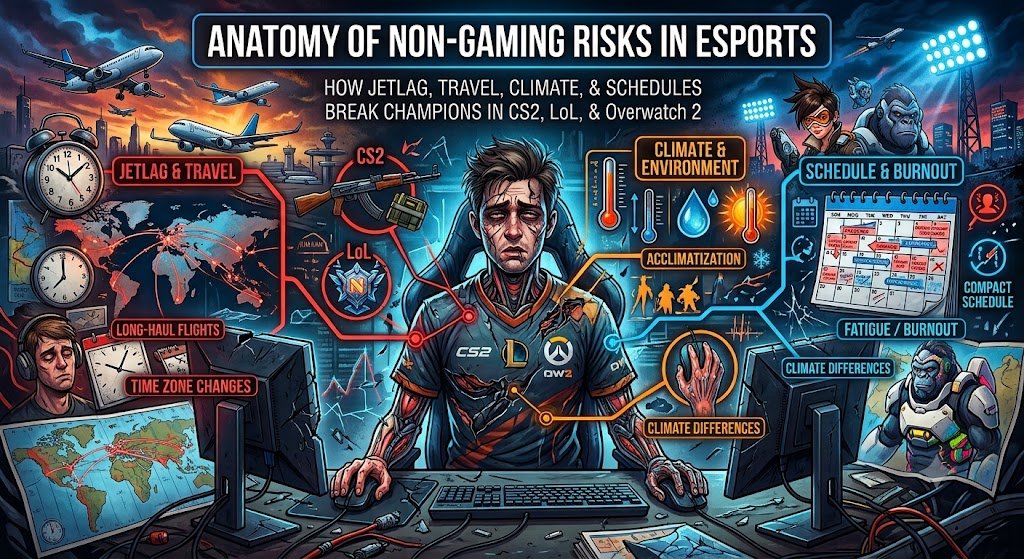
Major international championships attract enormous attention from analysts and bettors. However, the absolute majority of handicappers make a standard mistake: they evaluate solely dry numerical statistics — K/D rating, win rate on specific maps, Baron capture success, or attack side win percentage.
In reality, esports is a realm with extreme demands on visual-motor reaction speed, cognitive functions, and the nervous system. When rosters move across continents, navigating complex visa processes, 15-hour flights, and flight delays, physiological and logistical factors come to the forefront. A team with an 80% win rate on paper can easily lose to an underdog simply because its captain gets 3 hours of sleep a night, and their aimer hasn't adapted to the timezone shift yet.
This article provides an in-depth analytical breakdown of non-gaming risks across three leading disciplines — Counter-Strike 2, League of Legends, and Overwatch 2.
Table of Contents
Anatomy of Jet Lag and an Esports Athlete's Biological Clock
Logistical Chaos: Flights, Flight Delays, and Visa Stress
Tournament Ecology: Climate, Arena Temperature, and Nutrition
Impact of Schedule and Hidden Factors by Discipline
Counter-Strike 2: Micro-control, Morning Chaos, and Season Density
League of Legends: Draft Focus, Macro Fatigue, and Night Setups
Overwatch 2: Perception Overload, Micro-swaps, and Map Marathons
Comparative Analysis of Disciplines and Risk Management Parameters
Technical Pauses and Psychological Burnout
End of Season Factor and Burnout
Checklist: Evaluating Non-Gaming Risks Before Betting
Conclusion
1. Anatomy of Jet Lag and an Esports Athlete's Biological Clock
Jet lag or desynchronosis is a severe physiological condition resulting from a misalignment between a person's internal circadian rhythm and local time. In esports, the impact of jet lag is significantly more pronounced than in traditional sports, where physical exertion partially compensates for slight cognitive sluggishness through muscle memory.
Physiological Impact on the Player
Decline in Visual Response Speed: With a deficit in deep sleep phase, reaction time to an opponent's pixel appearing on screen drops by 15–30 milliseconds. In CS2 or Overwatch 2, this turns a top-tier aimer into an average player.
Degradation of Working Memory and Macro Analysis: A tired brain seeks to save energy and switches to simplified patterns. In LoL, this leads players to stop tracking the enemy jungler's movement through the fog of war, committing basic errors in lanes.
Reduced Emotional Stability and Tilt Threshold: Disrupting the circadian rhythm elevates cortisol levels. Players react critically sharply to losing the first round, surrender the initiative, and fall into apathy.
Flight Vector and Adaptation Difficulty
Few analysts consider a team's direction of flight:
Eastward Flight — e.g., from Europe to Asia: The hardest scenario. The body is forced to shorten its day. For every timezone crossed, a person needs at least 1 full day to recover. Flight from London to Shanghai with a 7-hour time difference requires 7 days to return to 100% form.
Westward Flight — e.g., from Europe to the USA: Tolerated much easier because the day is lengthened. Adaptation occurs at a rate of 1 day per 1.5 timezones.
2. Logistical Chaos: Flights, Flight Delays, and Visa Stress
An official tournament schedule never reflects the harsh realities of international logistics.
Arrival Off the Flight and Visa Issues
Complex visa procedures often result in esports players receiving their passports literally hours before departure. As a result, a team may arrive at the tournament venue just 10–12 hours before their opening match.
Instead of resting and analyzing opponents, players go through:
Multi-hour transfers and hotel check-in.
Urgent setup of equipment and configs in practice rooms.
Lack of proper nutrition and complete sleep.
Betting on such a team in the opening round, even if playing against a weak opponent, is the highest degree of risk.
Lost Luggage and Unfamiliar Gear
An esports player is extremely sensitive to their tools: mouse, pad, keyboard, headset. Airline luggage loss forces a player to use brand-new gear right on the LAN stage. Changes in sensitivity, mouse weight, or lift-off distance instantly break muscle memory built over years.
3. Tournament Ecology: Climate, Arena Temperature, and Nutrition
Environmental factors rarely make it into analyst reports, yet they directly impact players' physical condition.
Stage Thermal Regime and Cold Hands
Large stadium arenas often run powerful industrial air conditioning, maintaining temperatures around 18–19 degrees Celsius.
For a shooter player, cold hands are a disaster. Finger micro-control slows down.
Teams accustomed to playing in warm practice rooms or not using hand warmers show anomalously low win rates on the first maps of a match day.
Food Poisoning and Shifted Diets
A sharp change in cuisine — for instance, European or American teams traveling to tournaments in Asia or Latin America — regularly leads to gastrointestinal issues among esports players. A match played with a key player feeling unwell turns into a blow-out, even if the organization carefully conceals the roster's health problems.
4. Impact of Schedule and Hidden Factors by Discipline
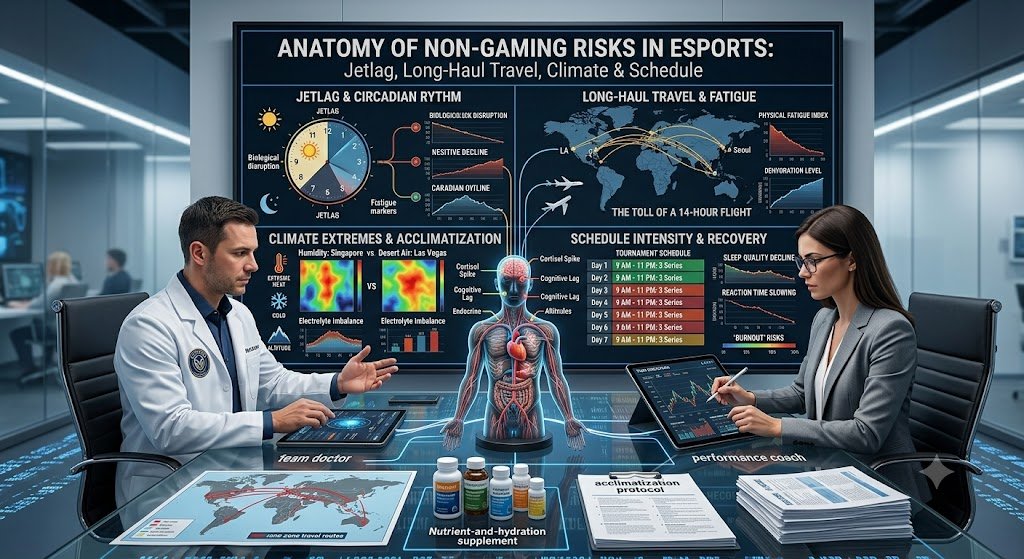
Counter-Strike 2: Micro-control, Morning Chaos, and Season Density
CS2 demands peak concentration in split-second windows. In this discipline, the physical state of the roster manifests instantly.
1. Morning Matches at 10:00 AM
At Majors and tournaments in the ESL and IEM series, first matches of the day are often scheduled for 10:00 AM local time. To be at the arena, a team must wake up at 07:00 AM. For esports athletes accustomed to practicing in the afternoon and night, morning matches become a true ordeal.
At 10:00 AM, exhausted favorites regularly lose pistol rounds.
In Bo1 maps during morning sessions, the maximum number of upsets or outsider victories is recorded.
2. Map Pool and Side Selection Under Sleep Deprivation
A fatigued team tends to choose simple, highly structured maps like Dust II or Mirage, avoiding complex coordination maps like Anubis or Vertigo. An analyst aware of a team's tough logistics can accurately predict a narrow map pool in the veto phase.
League of Legends: Draft Focus, Macro Fatigue, and Night Setups
In League of Legends, physical condition affects strategic intelligence and communication far more than mechanical buttons.
1. Draft Degradation on Late Maps
At international tournaments like Worlds or MSI, Bo5 series can drag on for 4–5 hours. If a match started late in the evening due to delays, maps 4 and 5 are played around midnight.
Coaches and players make fatal errors during the pick-and-ban phase due to fatigue: forgetting to ban opponent meta champions or picking compositions without counter-picks.
On map 5, the win rate of the team with superior physical conditioning increases by 20–25%.
2. Loss of Micro-Communication at Barons
Decisive teamfights at Baron Nashor or Dragon require perfect synchronization. Lacking sleep, junglers frequently mess up Smite timing, leading to stolen objectives and losing the entire map.
Overwatch 2: Perception Overload, Micro-swaps, and Map Marathons
Overwatch 2 is one of the most visually and emotionally intense disciplines. Due to 5v5 dynamics and an abundance of special effects, fatigue sets in much faster.
1. Sensory Overload
After 2–3 hours of continuous gameplay in Overwatch, players experience sensory saturation: the brain starts perceiving visual effects of opponent abilities less effectively.
DPS players lose focus and miss ultimate timings.
Supports fail to react in time to enemy tank engages.
2. Multiple Matches in a Single Day
Within OWCS or regional LAN qualifiers, teams sometimes have to play two matches in a day. The second series of the day for a team that previously played a grueling Bo5 marathon almost always ends in a drop in individual performance stats.
5. Comparative Analysis of Disciplines and Risk Management Parameters
Evaluating non-gaming risks for each discipline requires a differentiated approach to bet selection and bankroll management.
Counter-Strike 2
Logistics Vulnerability Level: Critical.
Main Non-Gaming Risk Factor: Morning matches at 10:00 AM; flight delays within 24 hours prior to start; equipment replacement due to lost baggage.
Impact on Markets: Drop in pistol round win rate; outsider victories on map 1 in Bo1 and Bo3.
Recommended Adjustment: Reduce standard bet size to 0.5% for any team arriving from another continent less than 72 hours before the match.
League of Legends
Logistics Vulnerability Level: High.
Main Non-Gaming Risk Factor: Long Bo5 series stretching into late night; draft errors due to cognitive fatigue; dietary changes at Asian LANs.
Impact on Markets: Increase in errors at key objectives; reduced map duration in games 4–5 of a series due to tilt.
Recommended Adjustment: Cap flat bet to 1.0% when betting on long series in international playoffs.
Overwatch 2
Logistics Vulnerability Level: Very high.
Main Non-Gaming Risk Factor: Sensory burnout when playing 2 matches a day; ultimate timing failures due to jet lag.
Impact on Markets: Map handicap failures; drop in accuracy percentage for sniper characters.
Recommended Adjustment: Bet 0.75% to 1.0% on a team's second game of the day, or skip pre-match entirely in favor of live betting.
6. Technical Pauses and Psychological Burnout
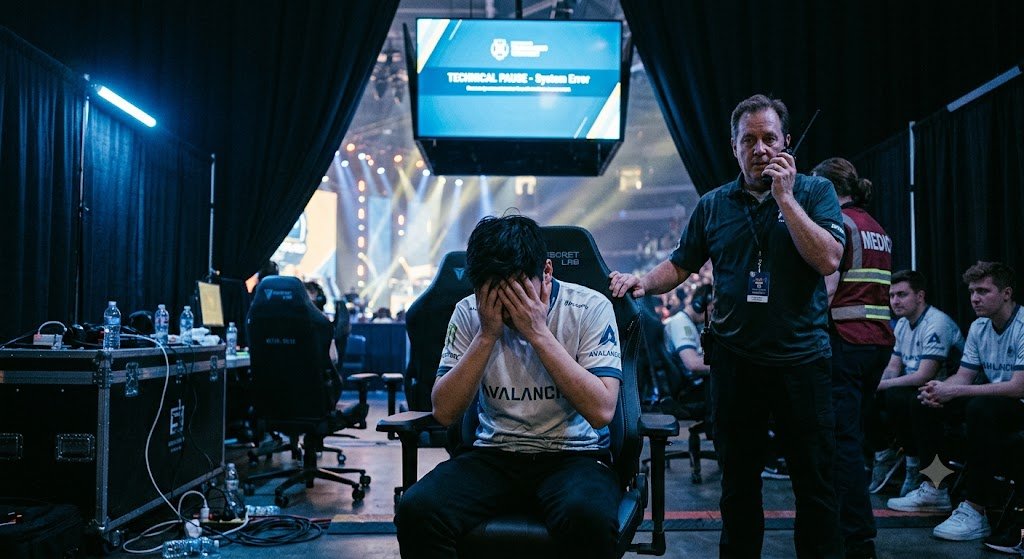
Technical delays at LAN tournaments are another hidden factor capable of turning a match around.
Pre-Game Delays: If a match is delayed by 2–3 hours due to server, anti-cheat, or broadcast issues, players remain in a "standby mode." Adrenaline levels spike, triggering emotional burnout before they even step onto the map.
Pauses During Crucial Rounds: In CS2, a 30-minute tech pause at 11:11 breaks the attacking team's momentum. A team that was crumbling and losing round after round gets a free chance to catch its breath, calm down, and discuss tactics.
Psychological Resilience of Rosters: Experienced Tier-1 rosters with staff psychologists handle delays calmly. Young teams lose match sharpness during lengthy halts and surrender the series once play resumes.
Use Ensitics.io as your pre-match checklist — try it for free → ensitics.io
7. End of Season Factor and Burnout
The modern esports calendar is overloaded. Top teams play 100 to 150 maps a year while constantly traveling.
Psychology of Celebrating Vacation
In the final tournaments of the year in December or right before the summer break in July, many players' motivation drops:
Teams subconsciously think about vacation rather than maximizing results.
Motivation for rosters planning roster changes immediately after the tournament drops to zero.
It is crucial for an analyst to track reshuffle rumors and insider info: if players know the roster is breaking up after the championship, their dedication on stage drops drastically.
8. Checklist: Evaluating Non-Gaming Risks Before Betting
Before placing a bet on a LAN tournament match, always verify against the following checklist of non-gaming factors:
Arrival Date and Time: Did the team arrive at the venue at least 72 hours before the opening match?
Latitude and Timezone: Does the time difference exceed 4 or more hours compared to the roster's previous location?
Match Start Time: Is the match played in the morning slot from 10:00 AM to 12:00 PM or late at night after 10:00 PM?
Condition of Gear and Luggage: Were there reports of delayed luggage, or lost mice/headsets for key players?
Today's Schedule: Is this the team's first or second match of the day?
Upcoming Reshuffles: Are there rumors or official announcements regarding roster changes immediately after the event?
Microclimate History: Have players complained on social media about food poisoning, cold arena temperatures, or bad hotels in the last 24–48 hours?
9. Conclusion
A forecaster's skill today is defined not by opening a math portal with stats and looking at a roster's raw K/D, but by assembling a vast mosaic of physiology, logistics, psychology, and in-game nuances.
Jet lag, multi-hour flights, flight delays, and long-term emotional burnout create abnormal deviations in bookmaker odds. Systematically accounting for these non-gaming factors allows you to spot a favorite's vulnerability in time, lower risks to your bankroll, and find high-value opportunities where the public sees only random upsets.
FAQ
What does it mean to bet on esports smarter? Betting smarter means replacing intuitive decisions with a consistent analytical process: confirming rosters, verifying current form, evaluating odds value, and placing wagers only when facts clearly support your choice. This doesn't guarantee winning every bet, but it increases decision quality over time, turning the process into measurable results.
How do I gain an edge in esports betting? An edge is achieved by regularly finding situations where your assessment of the outcome is more accurate than what bookmakers priced into the odds. This requires repeatable pre-match analysis, honest tracking of stats, and selectivity — the ability to skip matches that don't fit your criteria instead of betting on everything.
Should I use handicappers or analyze matches myself? Handicappers make money selling predictions, not necessarily from those predictions being profitable. The only way to know if an analytical process works is to run it yourself and track results honestly. AI prediction tools like Ensitics.io provide objective data-driven signals without the conflict of interest inherent in paid handicappers — but the final decision is always yours.
How quickly will I know if my betting strategy works? You need to place at least 50 bets before drawing initial conclusions, and over 100 before trusting identified patterns. On smaller samples, randomness dominates: you might hit a 70% win rate over 20 bets purely by luck, or 40% due to a temporary losing streak. Track stats regularly and summarize monthly, not after every match day.
What is the difference between High Confidence and Value Spotter signals on Ensitics.io? High Confidence signals focus on reliability — the model highlights matches where statistics strongly point to a specific winner. Value Spotter signals target mathematical expectation — finding matches where bookmakers underestimate a team's chances. The former yields higher hit rates at lower odds. The latter offers higher potential returns, but comes with greater variance. Most analysts combine both methods depending on bankroll size.
→ Read also: Most Common Esports Betting Mistakes (and How Data Helps Fix Them) → Read also: Best Esports Prediction Tools in 2026 — Ranking and Reviews

OpTic Texas vs Miami Heretics CDL Playoffs 2026 Prediction: The Favorite Aims for Victory
In the decisive stage of the Call of Duty League 2026 season, the champions of Major 4, OpTic Texas, will face the relentless Miami Heretics. We analyze the teams' chances in this Bo5 series.
Esports World Cup 2026 Dota 2 Favourites: Who Will Win in Paris?
As always, every top-tier tournament has its favourites. Some teams arrive in incredible form, others have championship-winning experience, while a few are simply too talented to ignore. Here's a look at the biggest contenders to win the Esports World Cup 2026.
Live Esports predictions: How to make decisions based on picks and the first minutes of the match in LoL, R6, and Overwatch
Live esports betting requires quick analysis of what is happening on screen. We break down how to use picks, drafts, and the first minutes of matches in League of Legends, Rainbow Six Siege, and Overwatch to make a more balanced assessment of how the game will unfold.