What Is a Value Bet and How to Find Value Bets in Esports
A value bet is a wager where the actual probability of an event is higher than the odds imply. Learn how to find value bets and calculate positive EV in esports.

A value bet is a wager where the bookmaker's odds are higher than the fair price relative to the actual probability of the outcome.
Simply put, a bookmaker might think a team has a 30% chance of winning and set the odds at around 3.33. If, after your own analysis, you believe the team's winning probability is not 30% but, for example, 38%, potential value arises.
The core concept is not about guessing the outcome of a single specific match. A value bet can lose. The point lies elsewhere: if you place such bets consistently over the long run, the expected value should be positive.
This is why value betting differs from simply picking the most likely winner.
How a Value Bet Works

To understand the principle, it is enough to compare the odds with your own probability assessment.
Suppose a bookmaker offers odds of 3.50 on an underdog winning in CS2.
Let's convert the odds into implied probability:
1 / 3.50 × 100 = 28.6%
This means odds of 3.50 correspond to roughly a 28.6% probability before factoring in the bookmaker's margin.
Now assume that after analyzing team form, map pool, head-to-head records, and roster changes, you estimate the underdog's win probability at 35%.
Here is what we get:
Probability implied by the odds — 28.6%;
Your assessment — 35%;
Difference — 6.4 percentage points.
This represents a potentially valuable bet.
However, it is crucial to understand: 35% is your model or estimate, not an objective truth. If your estimated probability was inflated, real value might not actually exist.
The Value Bet Formula
For a quick assessment, you can use the expected value (EV) formula:
EV = (Win Probability × Decimal Odds) − 1
In our example:
EV = 0.35 × 3.50 − 1 = 0.225
Or +22.5%.
A positive value means that, based on this probability assessment, the bet has a positive expected return.
However, this only works provided that your 35% estimate is genuinely close to reality.
That is why finding value is primarily a task of properly evaluating probabilities, rather than chasing high odds.
What Odds Can Be Considered Value
If you believe a team's win probability is 40%, the fair odds can be calculated using the formula:
1 / 0.40 = 2.50
This shows that odds of 2.50 roughly correspond to your probability estimate. If the bookmaker offers 2.50, there is no noticeable edge. If the odds are 2.80 or 3.00, potential value emerges.
For quick reference, you can keep several benchmark numbers in mind:
Odds of 1.50 correspond to roughly a 66.7% probability;
Odds of 2.00 — 50%;
Odds of 2.50 — 40%;
Odds of 3.00 — 33.3%;
Odds of 3.50 — 28.6%;
Odds of 4.00 — 25%;
Odds of 5.00 — 20%.
At the same time, keep in mind: this is merely implied probability. It does not indicate how accurate the bookmaker actually is, but simply allows you to compare the odds against your own calculation.
Where to Find Value in Esports
Searching for value in CS2, LoL, and MLBB is particularly interesting because the betting lines do not always equally factor in match-specific nuances.
Use Ensitics.io as your pre-match checklist — try it for free → ensitics.io
CS2
In CS2, one of the primary sources of value can be the map pool.
A team might appear weaker by general rating, yet end up with a highly favorable map veto. For instance, a favorite may boast a high season win rate, but most of those wins were recorded on maps that will be banned in the upcoming series.
You should also evaluate:
Recent map results;
Round differentials;
Performance on CT and T sides;
Individual player form;
Roster substitutions;
Head-to-head records against opponents with similar playstyles.
Sometimes the market evaluates a team based strictly on overall ranking, even though the specific matchup parameters favor them much less.
League of Legends
In LoL, drafting and playstyle carry immense weight.
A team might possess a lower overall ranking but secure a comfortable champion combination against a particular opponent.
Look beyond raw win rate and analyze:
How the team starts games;
How effectively they snowball early leads;
Which champions are in their comfort pool;
How consistently they secure objective control;
What issues the favorite encounters against specific playstyles.
If the market relies heavily on reputation while draft and lane matchups favor the underdog, value can often be uncovered.
MLBB
In MLBB, a similar dynamic is shaped by the synergy of draft, tempo, and map control.
Situations where an underdog secures strong hero combos that directly counter the favorite's chosen game plan are especially noteworthy.
Recent roster adjustments and individual player momentum must also be taken into account. In team esports, a single in-form or erratic player can drastically alter a team's actual performance level.
Value Does Not Equal Betting on the Underdog
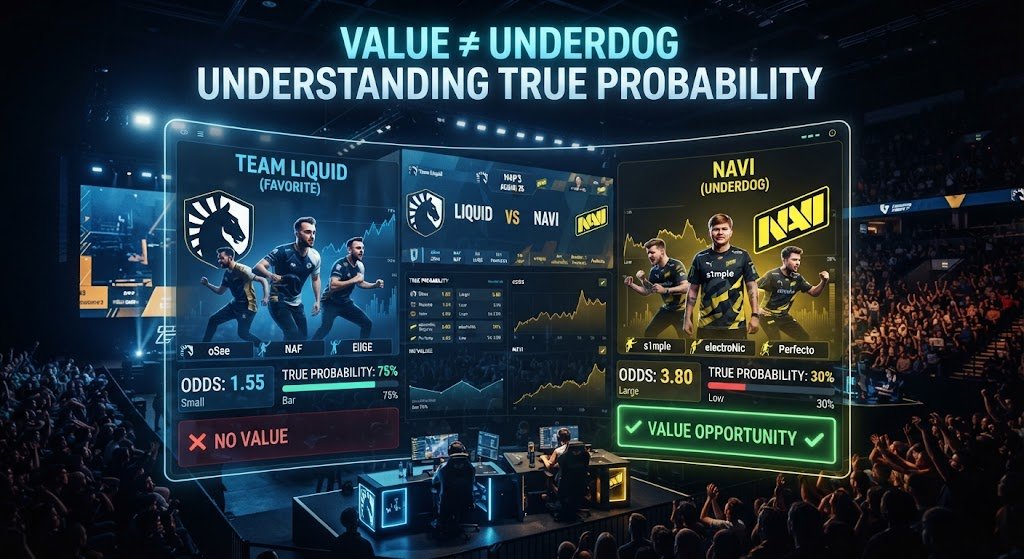
This is one of the most critical takeaways.
A value bet can be placed on a favorite just as easily as on an underdog.
Suppose a bookmaker offers odds of 1.70 on a favorite. This implies a win probability of around 58.8%.
If your analysis indicates their true winning chances stand at 65%, the bet contains value.
Searching for value exclusively among massive odds is a fundamental mistake.
Sometimes the highest value is found backing the favorite when the market fails to give enough weight to their structural advantage.
How to Find Value Bets Step by Step
It is best to begin your analysis with the match itself rather than looking at the odds first.
Step 1. Evaluate the Teams
Examine current form, active rosters, recent matches, and the quality of their opposition.
Step 2. Identify the Decisive Match Factor
In CS2, this might be the map pool; in LoL, draft composition and early-game pacing; in MLBB, hero picks and objective scaling.
Step 3. Estimate Outcome Probability
Here you must answer the essential question:
What is the probability of this specific outcome occurring?
For instance, you assess a team's win probability at 42%.
Step 4. Convert Probability to Fair Odds
Apply the formula:
1 / 0.42 = 2.38
This shows that the fair odds are approximately 2.38.
Step 5. Compare with Market Odds
If the bookmaker offers 2.20, there is no potential value.
If they offer 2.50, a potential statistical edge exists.
Step 6. Validate Your Assessment
This is the most critical stage.
If your 42% probability stemmed merely from a gut feeling that a team "looks good," mathematical calculations will not protect you.
Value only exists when your probability assessment is accurate and grounded in data.
Why You Cannot Simply Pick the Highest Odds
High odds do not inherently imply value.
If a team is priced at odds of 5.00, the market implies around a 20% win chance. If you estimate their realistic chance at only 12%, there is no value whatsoever.
Even odds of 10.00 can represent a terrible wager.
Therefore, the right question is not:
"Where are the highest odds?"
It is:
"Where are the odds higher than my fair price assessment?"
This is a fundamental distinction.
How Not to Confuse Value with a Regular Prediction
You can correctly predict a winner and still place a poor bet.
Suppose you are confident a favorite has a 70% chance of winning. The bookmaker offers odds of 1.25.
At first glance, the pick seems solid and reliable.
However, the fair odds for a 70% probability are:
1 / 0.70 = 1.43
This shows that odds of 1.25 are far too low relative to your calculated probability.
The team might win the match, but taking that price does not constitute a profitable wager long-term.
Conversely, betting on a team with only a 35% win probability can be mathematically sound if the available odds are high enough.
The Main Mistake: Overestimating Your Own Probability

The most difficult part of value betting is not the math.
The real challenge is that people easily convince themselves that their judgment is sharper than the bookmaker's pricing model.
This bias is especially pronounced following a string of successful bets.
To minimize subjective bias, track your pre-match assessments and evaluate your accuracy over a significant sample size.
If you consistently evaluate a team's win rate at 60% and they win far less frequently, your predictive model requires calibration.
Value Proves Itself over the Long Run
A single value bet proves nothing.
Even if an outcome truly has a 40% win probability, the 60% chance of a loss remains. That is a natural statistical reality.
For this reason, value betting cannot be judged on a single outcome, but rather across a large volume of bets.
A sample of 10 bets produces mostly random variance. 100 bets provide clearer insights, and several hundred bets allow you to accurately gauge the validity of your model.
Never dismiss a bet as poor simply because the selected team lost.
If the probability was calculated accurately, a loss on the day does not mean value was absent.
How to Find Value Before a Match
Before placing a bet, run through a straightforward checklist:
What is my estimated probability for this outcome?
What probability is implied by the bookmaker's odds?
Why does my assessment differ from market consensus?
Is there an objective reason for this discrepancy?
Have I accounted for rosters, current form, maps, or champion drafts?
Am I overvaluing a single standout recent performance?
How does my estimate look if I eliminate emotional bias toward the team?
Having clear, objective answers to these questions makes your betting approach far more structured.
Conclusion
A value bet is not about chasing the highest odds, nor does it mandate betting on the underdog. It is a scenario where available odds exceed your estimated fair value.
To locate value bets, first evaluate the true probability of an event, convert it into fair odds, and compare that figure to what the bookmaker is offering.
In esports, success relies heavily on looking past surface statistics to understand match context: the map pool in CS2, draft priority and tempo in LoL, and hero counters in MLBB.
Most importantly, avoid forcing value into every match. If there is no clear, objective justification for a price discrepancy, pass on the match. Often, skipping a bet is far more profitable than inventing value where none exists.
Read also: The Psychology of Tilt: How Esports Players' Emotions in CS2 Ruin Bulletproof Parlays and Predictions; Bankroll Management in Esports: How Not to Lose Everything on CS2, LoL, and Overwatch 2 Tournaments; Artificial Intelligence vs. Human Expert: Can AI Completely Replace Esports Analysts?
FAQ
What does 322 mean in esports?
322 is esports slang for match-fixing. The term originated from an infamous Dota 2 incident where a professional player bet against his own team to win $322.
How can you tell if a match might be fixed?
A single indicator is rarely definitive. Typically, one should monitor several factors simultaneously: tournament tier, team reputations, sudden erratic odds swings, suspicious in-game mistakes, and tournament organizer credibility.
Does match-fixing happen in Tier-1 tournaments?
While it cannot be completely ruled out, the likelihood of 322 incidents in top-tier international events is vastly lower due to high player salaries, reputational risk, and intense oversight from organizers, fans, and bookmakers.
Why do bookmakers adjust their odds?
Odds movements usually reflect breaking roster news, player injuries, shifts in team form, or heavy betting volume on a specific outcome. However, sharp line movements without identifiable reasons can sometimes signal suspicious activity.
What is spot-fixing?
Spot-fixing is the act of manipulating a specific in-game event rather than the final result of the match. Examples include conceding First Blood in Dota 2 or deliberately dropping the opening pistol round in CS2.
Is it worth betting on lower-tier tournaments?
Beginners should focus on tier-1 international championships. Reliable information on teams and organizers is harder to verify in obscure online tournaments, and the risk of encountering compromised matches is noticeably higher.

5 Signs of a Promising Underdog in CS2, LoL, and MLBB
An underdog is not always a weak team. Sometimes high odds conceal true strength. We analyze five signs of promising underdogs in CS2, LoL, and MLBB before the match.
What Betting Markets Are Available in Dota 2 Besides Match and Map Winner?
In short, besides match and map wins in Dota 2, you can bet on handicaps, totals, correct series score, first blood, next kill, total kills, first Roshan, tower count, map duration, player stats, and tournament winners.
Tilt Psychology: How Esports Players' Emotions in CS2 Ruin Ironclad Expresses and Predictions
Esports seems like a realm of pure math and numbers. However, as long as real people sit behind the monitors, tilt remains the main hidden risk factor. We break down the chain reaction of emotional breakdowns, the first map syndrome, and how to read team mental states in real time.