Betting on Player Stats in CS2: When to Pick Over/Under on Key Rifler Frags
Betting on individual kill totals in CS2 requires a deep understanding of player map roles. We analyze how the MR12 format changed player statistics, when to bet Over or Under on key rifler kills, and what to focus on during pre-match analysis.
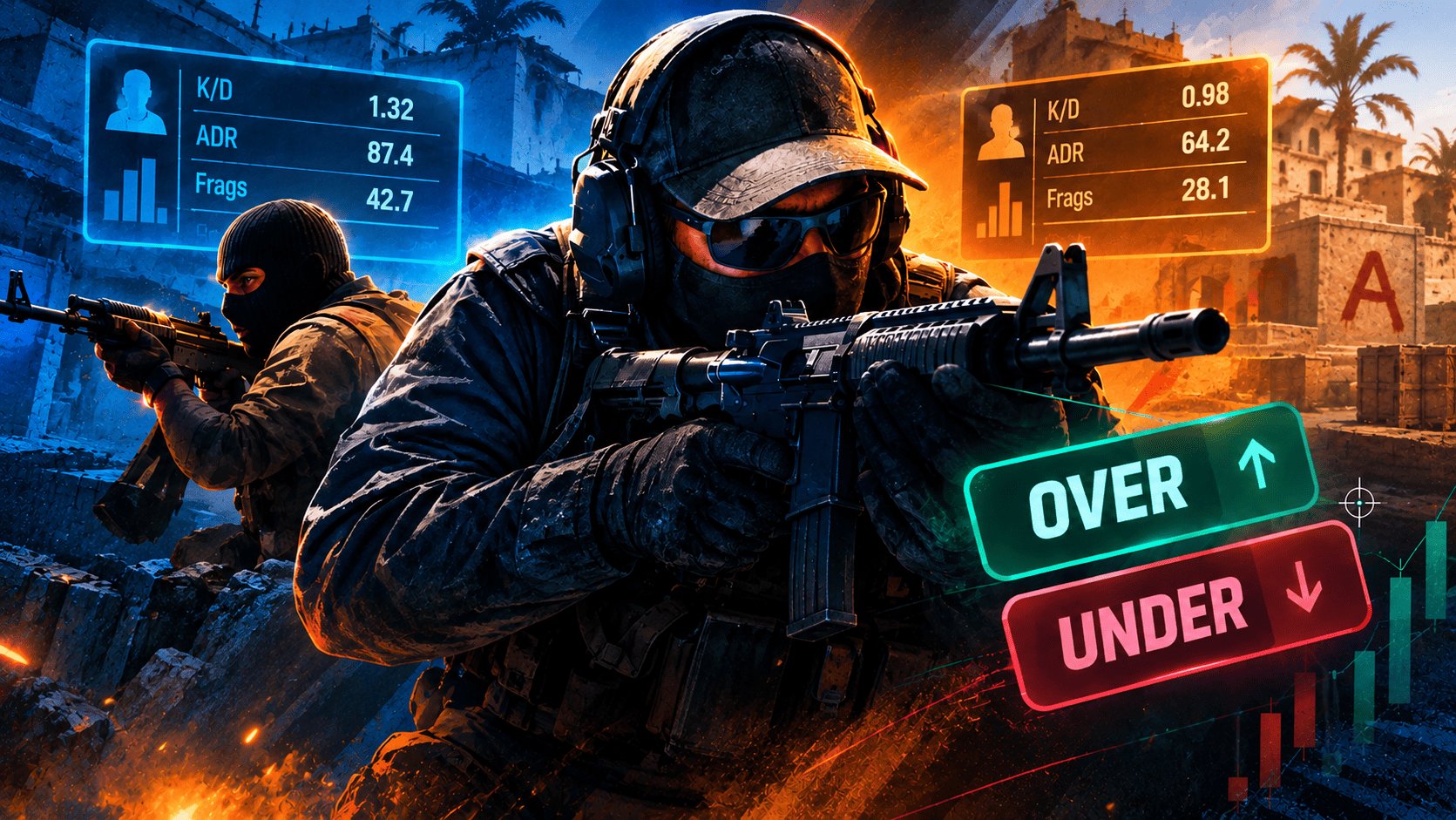
In Counter-Strike 2, betting has long gone beyond simply picking the match winner (P1/P2) or total maps. One of the most intriguing and potentially profitable markets has become individual player statistics — specifically, kill totals (Over/Under) per map or across the entire series.
Bettors pay particular attention to key riflers — primary firepower support players and secondary fraggers (for example, b1t, ropz, frozen, spinx, NiKo, flameZ). Unlike snipers (AWPers), whose stats are often heavily tied to team economy, riflers have a more consistent presence across the map, yet their individual numbers are influenced by numerous hidden factors.
In this article, we will examine how to properly analyze individual rifler totals and identify the scenarios where an Over or Under bet offers the highest expected value.
Use Ensitics.io as your pre-match checklist — try for free → ensitics.io
1. CS2 Nuances: Why Statistics Changed Compared to CS:GO
The transition to Counter-Strike 2 and the MR12 format (a maximum of 12 rounds per half instead of 15) radically altered how player totals work:
Fewer rounds — higher variance. While an average map previously lasted 25–28 rounds, the norm now is 20–22 rounds. This makes it harder for bookmakers to set accurate totals, and a single bad round hurts a player's final stats much more severely.
Peeker’s Advantage and the rifling edge. Altered gunplay mechanics and subtick have made rifles (especially the Galil AR and AK-47) even deadlier when aggressively peeking. Aggressive riflers with strong individual form rack up kills faster than they did in CS:GO.
Economic changes. A lost pistol round followed by a force-buy leaves even less margin for error. If a team is stuck in a prolonged economic deficit, a rifler is forced to run around with SMGs or default pistols, severely curbing their fragging potential.
2. When to Bet OVER on Rifler Kills?
An Over bet is justified when multiple favorable factors align: map structure, player role, and the expected match scenario.
A. A Tight, Contested Match is Expected (22+ Rounds)
Kills are a direct function of total rounds played. When evenly matched opponents clash (e.g., FaZe Clan vs. Vitality), the likelihood of over 21.5 rounds on a map is very high. The more rounds played, the greater the chance that a star or consistent rifler clears their line (e.g., 15.5 or 16.5 frags).
B. Matches on "Comfort Maps"
Every rifler has signature maps where they serve as a primary defensive anchor or take on the first entry / second-contact role on T-side, getting plenty of space.
Example: A rifler playing A Ramp / Palace on Mirage or B-long on Anubis consistently picks up 4–6 kills on rotations and push holds alone.
What to check: Go to HLTV -> player profile -> Stats tab -> Individual stats by map over the last 3–6 months. If a player holds a rating above 1.15 and an average KPR (kills per round) > 0.72 on that map, they are an excellent candidate for the Over.
C. Defending on the Favorable Side (CT-heavy / T-heavy Maps)
If a rifler's team begins on their stronger half, the player can rack up 10–12 kills in the first half alone. This builds a fantastic foundation to cover the total, even if the team falters in the second half.
D. The Team's AWPer is Inconsistent or Opponents Neutralize the Sniper
When the AWPer is having an off game (or the opponent shuts them down with precision smokes and flashes), the primary burden of trading and dealing damage shifts to second-contact riflers.
3. When to Bet UNDER on Rifler Kills?
Betting the Under is often psychologically harder, but mathematically these bets win just as frequently, and the odds can offer immense value.
A. High Probability of a Quick 2-0 or a Blowout
If a heavy favorite faces an underdog, the match could swiftly conclude 13-4 or 13-5. In just 17–18 rounds, even a world-class rifler physically may not find the time to secure 15–16 kills, simply because opponents fall to teammates or utility.
B. Unfavorable Map Roles and Matchups
Certain maps require a rifler to handle the "dirty work":
The player acts as hard entry, flashing in first and sacrificing their life for trade space.
The player is parked on a lonely anchor spot (e.g., B-site on Nuke or B-site on Inferno), which the opponent might only hit 2 or 3 times in the entire match.
If the opposing team is known to systematically avoid the site held by your rifler, their kill total is almost destined to hit the Under.
C. Packed Schedule, Fatigue, and Slumping Form
Esports athletes aren't machines. Constant travel between LAN tournaments, jet lag, and grueling stretches of 3–4 matches over a couple of days take a severe toll on micro-control and reaction times (which riflers need more than anyone). If a player has shown a K/D slump across their last 3–5 matches, betting their Over is perilous.
4. Pre-Bet Checklist for Individual Totals
Before placing a bet on a rifler's frag total, ask yourself these 5 questions:
What is the expected map pool? Will they play a map where this player boasts top-tier stats?
What is the player's role on this map? Are they an early fragger, a clutch closer, or a site anchor stranded away from the action?
What is the projected round total? Will it be a close contest (20+ rounds) or a quick blowout?
Who is their direct positional opponent? (For instance, if a rifler takes connector duels against one of the world's premier snipers, winning those aim duels will be remarkably difficult).
Where is the event held? A stadium LAN in front of a live crowd or an online qualifier? Many young riflers post significantly lower numbers on LAN due to stage pressure.
Conclusion
Betting on rifler kill totals in CS2 is all about micro-details. Long-term profitability belongs to bettors who watch demos, understand player micro-roles within the team, and can forecast the flow of the match rather than simply relying on "average HLTV rating."
Use the MR12 format to your advantage, track map dynamics, and don't shy away from betting the Under on anchor riflers in matches with blowout potential!
Read also: The Psychology of Tilt: How Pro CS2 Players' Emotions Ruin Parlays and Predictions; Bankroll Management in Esports: How to Avoid Busting in CS2, LoL, and Overwatch 2; Artificial Intelligence vs Expert Opinion: Can Neural Networks Fully Replace Esports Analysts?
FAQ
What is 322 in esports?
322 is slang for a match-fixing incident. The term originated from a well-known Dota 2 case where a player bet against his own team to win $322.
How can you tell if a match might be fixed?
A single clue is not enough. You should usually evaluate several factors simultaneously: tournament tier, team reputations, sudden line movements, suspicious in-game moments, and tournament organizer transparency.
Does match-fixing happen at Tier-1 tournaments?
Yes, it cannot be ruled out completely. However, at major international events, the likelihood of 322 is substantially lower due to high player salaries, reputational risks, and close scrutiny from organizers, viewers, and bookmakers.
Why do bookmakers adjust the odds?
Most often, this stems from roster updates, injuries, shifts in team form, or heavy betting volume on a specific outcome. However, sharp line movement without an obvious cause can serve as a red flag for a suspicious match.
What is spot-fixing?
Spot-fixing is an attempt to manipulate a specific in-game event rather than the overall match result. For example, giving up First Blood in Dota 2 or deliberately losing the pistol round in CS2.
Is it worth betting on obscure tournaments?
If you are a beginner, it is better to focus on major international championships. Obscure online tournaments make it harder to find reliable team and organizer info, and the risk of encountering match-fixing is objectively higher.

Kelly Criterion in Esports: How to Calculate the Ideal Bet Size Based on Probabilities
Learn how to protect your bankroll from emotional esports bets with the Kelly Criterion. Discover how to identify value, calculate stakes, and adapt risk via Quarter-Kelly.
How to Turn Baron and Dragon Fights into Profitable Live Bets in LoL
Epic objectives in LoL are the primary catalyst for thrilling comebacks and swift map finishes. We explore how to predict Soul Point fights, avoid Baron traps, and profit from live betting.
Agent Synergy in Valorant: Why a Pick Without a Duelist or Initiator Is Doomed to Fail
Agent selection in Valorant often decides the outcome before the first round. We analyze why lacking a Duelist costs space, a pick without an Initiator blinds the team, and how this impacts every map.