A step-by-step analyst checklist: 10 steps before predicting CS2, Dota 2, and Valorant matches
What factors should you consider before predicting a match? We break down a step-by-step analyst checklist for CS2, Dota 2, and Valorant: from team form to motivation.
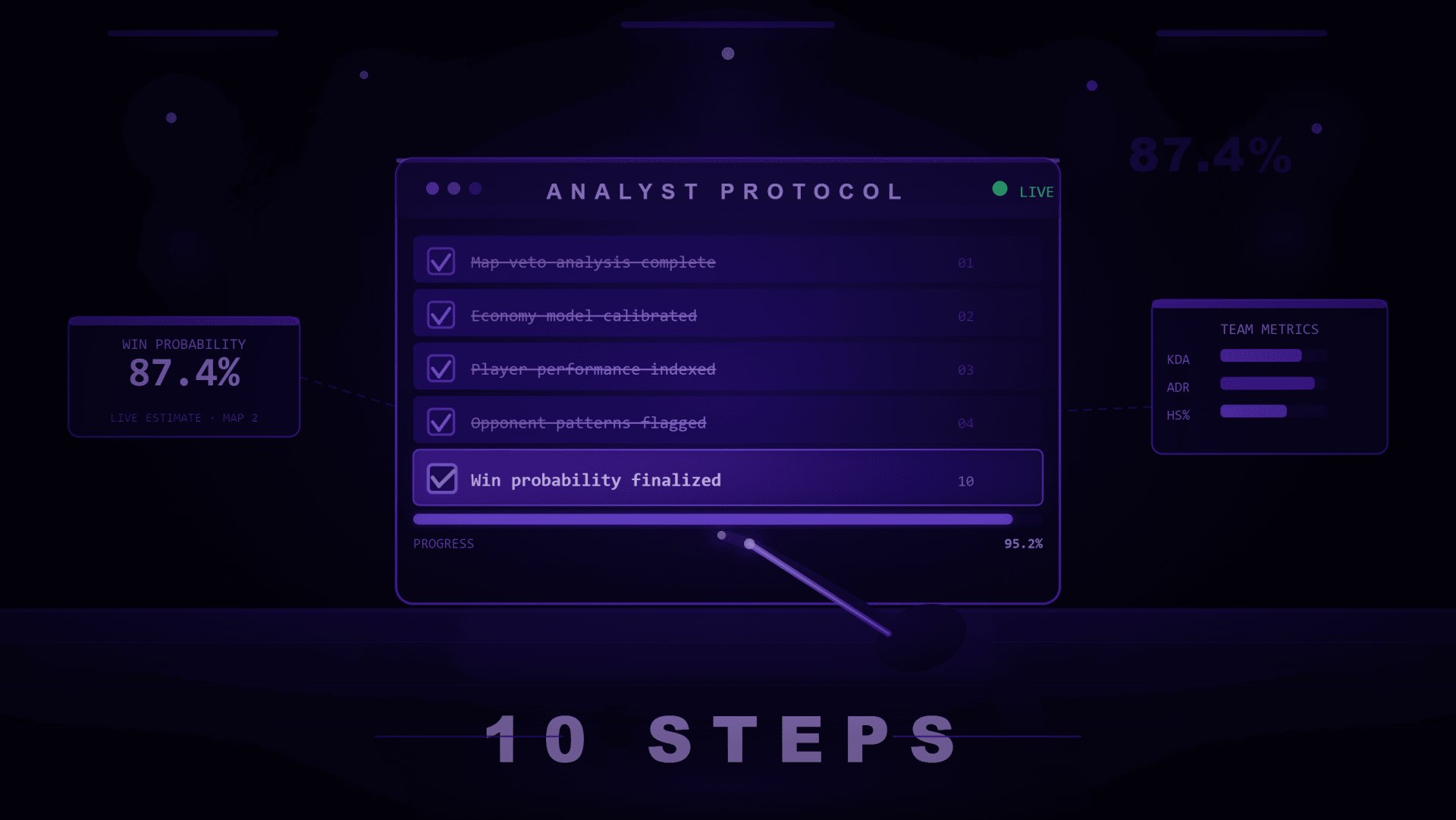
Many players look only at the bookmaker's odds or the teams' recent results. This approach allows them to see only part of the picture. For a high-quality prediction, it is necessary to consider many factors that directly affect the probability of winning for one side or the other.
Professional analytics is built on consistent data analysis. Regardless of the discipline — CS2, Dota 2, or Valorant — there is a basic set of steps that helps to assess a match more objectively and avoid common mistakes.
Table of Contents
Step 1. Assessing current team form
Step 2. Analyzing the opponent level
Step 3. Checking head-to-head records
Step 4. Analyzing roster changes
Step 5. Studying player statistics
Step 6. Analyzing maps and play preferences
Step 7. Considering tournament motivation
Step 8. Analyzing schedule and workload
Step 9. Tracking odds movements
Step 10. Final risk assessment
Conclusion
FAQ
Step 1. Assessing current team form
The first thing to pay attention to is the results of recent matches. It is important to understand not only the number of wins and losses, but also the quality of the team's play. Sometimes a team wins a series of matches against weak opponents, which creates a false impression of their strength.
Current form allows you to understand how consistently the team is performing right now and whether they are ready to show a high level in the upcoming match.

Step 2. Analyzing the opponent level
Statistics do not always reflect the real picture. A team may have a high win rate, but if most of the matches were played against weaker opponents, such results require additional checking.
Comparing the level of opposition helps to determine the real strength of the team and avoid overestimating statistics.
Step 3. Checking head-to-head records
The history of head-to-head matchups remains an important factor when analyzing a match. Some teams show good results against most opponents but struggle against a certain playstyle.
Head-to-head records allow you to identify such patterns and complement the overall picture before making a prediction.
Step 4. Analyzing roster changes
Even a single player substitution can significantly change a team's performance level. New players can strengthen the team, but they often need time to adapt.
When analyzing, it is important to consider the date of the latest changes, the number of matches played with the new roster, and the results after the changes.
Step 5. Studying player statistics
Team performance metrics are important, but individual player form is often the deciding factor. This is especially noticeable in matches between equal opponents.
Analysts evaluate player consistency, their contribution to team wins, and result dynamics over time.

Step 6. Analyzing maps and play preferences
In CS2 and Valorant, the map on which the match will be played is of great importance. Some teams show a high win rate on certain maps, while they experience serious problems on others.
In Dota 2, a similar role is played by game strategies, preferred heroes, and team style. Understanding strengths and weaknesses helps to more accurately assess the probability of success.
Step 7. Considering tournament motivation
Not all matches have the same importance. A group stage match and an elimination match often differ in the level of team preparation and player approach.
When analyzing, it is necessary to consider the participants' positions in the tournament bracket, the significance of the specific match, and the possible consequences of a defeat.
Step 8. Analyzing schedule and workload
A tight schedule can negatively affect even strong teams. A large number of matches in a short period of time increases the workload on players and reduces performance stability.
Extra attention should be paid to teams that have recently completed long series of matches or are competing in multiple tournaments at once.
Step 9. Tracking odds movements
Changes in odds often reflect the market's reaction to new information. This could be caused by roster news, changes in match conditions, or activity from big bettors.
Odds movement on its own does not guarantee a correct prediction, but it helps to identify matches that require additional study.
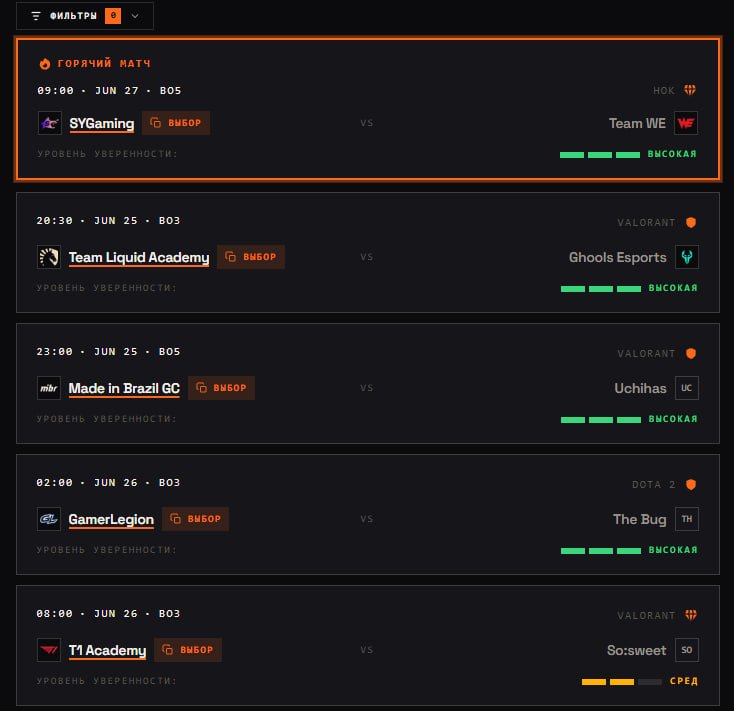
Use Ensitics.io as your pre-match checklist — try for free → ensitics.io
Step 10. Final risk assessment
After gathering all the information, it is important to combine the data into a single picture. Not every match is suitable for a prediction. Sometimes the number of uncertain factors is too high, and the best decision is to skip the bet.
A professional approach lies not only in finding promising options but also in the ability to skip questionable events.
Conclusion
Analyzing matches in CS2, Dota 2, and Valorant requires a comprehensive approach. No single metric can guarantee an accurate result, but a consistent study of team form, player statistics, map details, tournament motivation, and other factors allows you to significantly improve the quality of predictions.
Using a structured checklist helps analysts make decisions based on data, not emotions. This is precisely the approach that underpins professional esports match analysis.
FAQ
What does it mean to bet on esports smarter? Betting smarter means replacing intuitive decisions with a consistent analytical process: confirming rosters, checking current form, evaluating the value of odds, and opening positions only when the facts clearly support your choice. This does not guarantee winning every bet, but it improves the quality of decisions over time, turning the process into measurable results.
How do I get an edge in esports betting? An edge is achieved by regularly finding situations where your assessment of the outcome is more accurate than what the bookmakers built into the odds. This requires a repeatable pre-match analysis, honest tracking of statistics, and selectivity — the ability to skip matches that do not meet your criteria instead of betting on everything.
Should I use tipster services or analyze matches myself? Tipsters make money from selling tips, not necessarily from those tips being profitable. The only way to know if an analytical process works is to run it yourself and honestly record your results. AI-powered prediction tools like Ensitics.io provide objective, data-driven signals without the conflict of interest inherent in paid tipsters — but the final decision is always yours.
How quickly will I understand if my betting strategy is working? You need to make at least 50 bets before drawing first conclusions, and more than 100 before trusting identified patterns. Over a shorter distance, everything is determined by chance: you can get a 70% win rate out of 20 bets on pure luck, or 40% due to a temporary losing streak. Keep statistics regularly and review results once a month, not after every match day.
What is the difference between High Confidence and Value Spotter signals on Ensitics.io? High Confidence signals focus on reliability — the model flags matches where statistics clearly point to a specific winner. Value Spotter signals focus on mathematical expectation — they find matches where bookmakers underestimate the chances of one of the teams. The first option offers a higher win rate at lower odds. The second option brings more potential profit but comes with higher variance. Most analysts combine both methods depending on their bankroll size.
→ Read also: Most Common Errors in Esports Betting (and How Data Helps to Fix Them) → Read also: Best Esports Prediction Tools in 2026 — Ratings and Reviews

Dota 2 Team Performance Analysis: A Data-Driven Prediction Guide
How to analyse Dota 2 teams for match prediction: draft tendencies, net worth leads, hero performance, recent form, and how AI tools simplify it.
Liquipedia vs Ensitics.io: pros and cons for CS2, Dota 2 and LoL predictions?
Comparison of Liquipedia and Ensitics.io: which Is better for esports predictions?
How to bet on CS2, Dota 2, LoL smarter: a data-first approach
The best guide on how to bet on CS2, Dota 2, LoL and other esports smarter.